
You’re brushing your teeth, glance in the mirror, and notice a hard yellowish buildup along your gum line that just won’t budge. So you do what most of us do — Google it. And suddenly you’re down a rabbit hole of charcoal pastes, DIY dental pick sets, and vinegar rinses that promise a dentist-free deep clean.
Here’s the truth: some of those “hacks” can seriously damage your teeth. At O2 Dental Group, we want our patients across North Carolina to have the real information — so let’s break it all down.
First, Let’s Talk About Plaque vs. Tartar (They’re Very Different)
A lot of people use these words interchangeably, but understanding the difference is the key to understanding why tartar is such a stubborn problem.
Plaque is the soft, sticky film of bacteria that forms on your teeth every single day. The good news? It hasn’t hardened yet, so a toothbrush and floss can take care of it.
Tartar (also called calculus) is what happens when plaque isn’t removed within 24 to 72 hours. The bacteria-filled film reacts with the calcium and phosphate in your saliva and mineralizes — essentially turning into a rock-hard deposit that bonds directly to your enamel.
Once that transformation happens, you’re no longer dealing with a film. You’re dealing with a mineralized structure that’s mechanically bonded to your tooth surface. And because tartar is porous and rough, it acts like a magnet for even more plaque — creating a cycle that gets worse over time.
The Most Common DIY Tartar Removal Myths — Debunked
When patients come into our O2 Dental Group offices in Raleigh, Durham, Wilmington, or Southern Pines, we often hear about home remedies they’ve tried. Here’s what the science says about the most popular ones:
❌ Myth 1: DIY Metal Dental Picks
Stainless steel scalers are cheap and easy to find online — but using one at home is genuinely risky. Professional dental hygienists spend years learning the precise angles needed to dislodge tartar without scratching enamel. Without that training, you can permanently groove your tooth surface (creating new hiding spots for bacteria) or nick your gum tissue, which can lead to infection or gum recession.
❌ Myth 2: Vinegar, Lemon Juice, or Acidic Rinses
The idea here is that acid dissolves tartar. The problem? Tartar is made of the same minerals as your teeth. Any solution acidic enough to break down tartar will also erode your enamel — causing sensitivity, weakening your teeth, and setting you up for cavities.
❌ Myth 3: Charcoal or High-Abrasive Pastes
These might lift some surface staining, but they can’t break the bond of mineralized tartar. What they can do is act like fine sandpaper on your enamel — wearing down your protective layer while leaving the tartar completely intact.
So How Do Dentists Actually Remove Tartar?
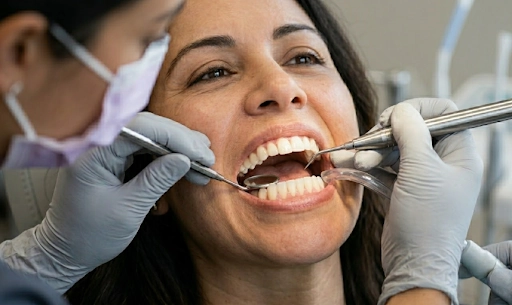
At O2 Dental Group, tartar removal is part of your professional cleaning and — in more advanced cases — a procedure called scaling and root planing. Here’s what makes it different from anything you can do at home:
Ultrasonic Scaling uses a device that vibrates at high frequency to create microscopic “cavitation bubbles” that shatter the tartar’s bond to the tooth — without harming the enamel underneath. It’s precise, effective, and comfortable for most patients.
Hand Instrumentation follows up with specialized instruments to clear any remaining deposits, especially the buildup hiding below the gum line (called subgingival tartar). This is the stuff no toothbrush, pick, or rinse can reach — and it’s often the most damaging if left untreated.
Why You Really Don’t Want to Leave Tartar Alone
This isn’t just a cosmetic issue. Untreated tartar buildup is an active, chronic infection in your mouth — and the consequences go well beyond bad breath.
- Gum disease — Tartar irritates gum tissue, causing it to pull away from the tooth and form pockets where bacteria thrive. Left untreated, this progresses to periodontitis, which destroys the bone supporting your teeth.
- Tooth loss — Advanced tartar buildup and the bone loss it causes is one of the leading reasons adults lose teeth.
- Systemic health risks — Research has linked the bacteria found in dental tartar to increased risk of heart disease, diabetes, and respiratory infections.
- Persistent bad breath — Tartar is porous, so it constantly harbors odor-producing bacteria. No mouthwash can fix that long-term.
What You Can Do at Home: Tartar Prevention
Removing tartar at home isn’t possible — but preventing it absolutely is. Here’s what actually works:
Brush for a full two minutes. Most people underestimate how long two minutes actually is. Use a timer. Pay extra attention to the back of your lower front teeth and your upper molars — those are the spots where tartar most commonly forms.
Floss every day. If you’re only brushing, you’re leaving roughly 35% of your tooth surfaces untouched. Flossing — or using a water flosser if traditional floss is tricky — disrupts the plaque between teeth before it can harden.
Try a tartar-control toothpaste. These contain ingredients like pyrophosphates or zinc citrate that interfere with the process of plaque mineralizing into tartar.
Watch what you eat and drink. Sugary and starchy foods feed plaque-producing bacteria. Rinsing with water after meals helps neutralize your mouth’s pH and slow the process.
Your Questions, Answered
Can an electric toothbrush remove tartar?
No — even the best electric toothbrush can only remove plaque. Once it’s hardened into tartar, only a professional cleaning will do the job. That said, a good electric brush is one of the best investments you can make in preventing buildup in the first place.
What about oil pulling?
There’s no scientific evidence that oil pulling removes tartar. It may modestly reduce bacteria in the mouth, but it cannot break down calculus.
Is tartar removal painful?
For most patients, a routine cleaning is completely comfortable. If you have significant buildup or sensitive gums, our team at O2 Dental Group can use numbing gel or local anesthesia to make sure you’re at ease throughout the visit.
How often should I get my teeth professionally cleaned?
Most adults do well with a cleaning every six months. If you’re prone to rapid buildup or have a history of gum disease, your dentist may recommend coming in every three to four months — which is common and nothing to worry about.
What happens if I just… never deal with it?
Eventually, the bone loss and gum recession caused by chronic tartar buildup will cause your teeth to loosen and, ultimately, fall out. It sounds dramatic, but it’s a very real and very preventable outcome.
The Bottom Line
There’s no safe way to remove tartar at home — but there is a very easy way to stay ahead of it: brush well, floss daily, use the right toothpaste, and show up for your professional cleanings.
At O2 Dental Group, our hygiene team makes the process as comfortable and stress-free as possible. We’ve designed our offices — in Raleigh, Durham, Wilmington, Fayetteville, Southern Pines, Siler City, and beyond — to feel nothing like what most people dread about the dentist. Modern technology, a friendly team, flexible scheduling, and financing options that make regular care accessible for everyone.
Don’t wait until a small problem becomes a big one. Schedule your professional cleaning at O2 Dental Group today — your gums (and your future self) will thank you.
 English