
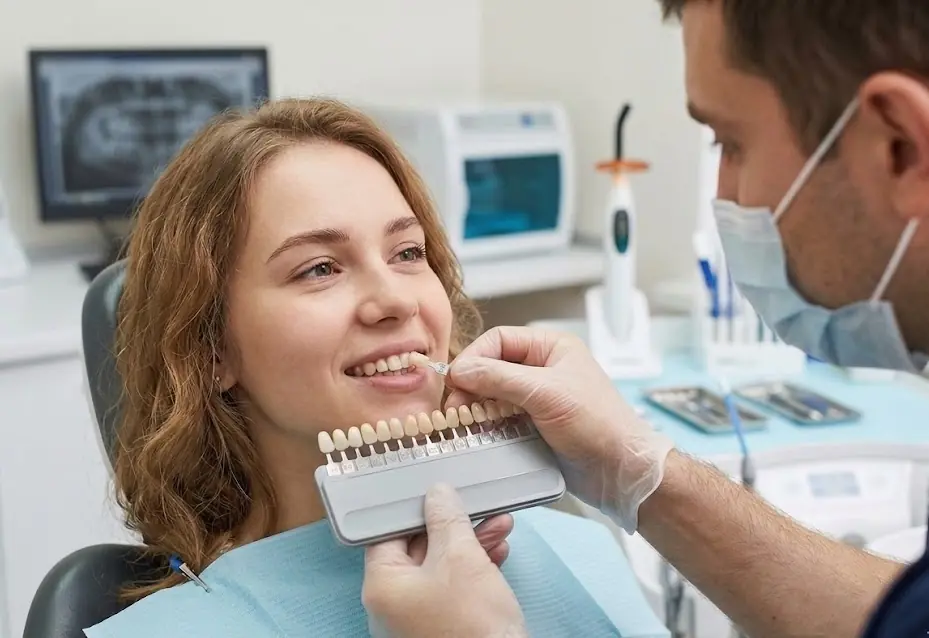
The word “custom” gets used loosely in cosmetic dentistry. Walk into almost any dental office and they’ll tell you their veneers are custom. What they often mean is that the shade was selected from a chart and the lab made something that fits your teeth.
That’s not the same as a veneer designed to your face.
A genuinely bespoke veneer result — the kind that looks natural rather than installed, and holds up for fifteen years — requires a different kind of process. It starts with proportion analysis, not shade selection. It involves wearing a physical trial smile before a single piece of porcelain is fabricated. It accounts for how light moves through ceramic, how the margin integrates with your gum line, and whether your bite places sustainable load on the restoration long-term.
If you’re researching custom veneers in Durham, this guide explains what the process looks like when it’s done correctly — and what questions to ask when you’re not sure it is.
What’s in this guide
- What “custom” actually means — and when it doesn’t
- The design process: Digital Smile Design and the trial smile
- Porcelain selection: feldspathic vs. e.max
- No-prep veneers: when they work and when they don’t
- Shade selection: from natural to Hollywood
- Protecting your veneers long-term
- FAQ: 10 common questions answered
What “Custom” Actually Means — And When It Doesn’t
Many practices use digital shade-matching software and describe the result as custom. The shade is selected from a preset library, the tooth shape is pulled from a digital template, and the lab fabricates what the template specifies. For many patients, the result looks fine. For patients who wanted something genuinely natural and specific to their face — it tends to look like veneers.
The difference shows up in three specific ways that are hard to articulate in a before photo but immediately obvious in person.
Light behavior
Natural teeth aren’t a single color. They’re layered — slightly more opaque at the center, increasingly translucent toward the biting edges. That translucency at the incisal edge creates what ceramists call a halo effect: a soft internal glow that reads as depth rather than surface. Template veneers are often uniformly opaque, producing a bright but flat result that looks artificial under natural light. Quality porcelain replicates the layered structure of real enamel, changing appearance subtly as the light source changes — which is exactly what natural teeth do.
Surface texture
Perfectly smooth porcelain reflects light like glass — and that’s not what enamel does. Natural enamel has subtle ridges and developmental lobes on its facial surface that scatter light in multiple directions simultaneously. When porcelain replicates that texture, the result reads as alive. When it doesn’t, it reads as a dental restoration. Skilled ceramists incorporate this micro-morphology into the surface of the final porcelain — it’s invisible to the eye but detected by light, and it’s the difference between natural and “done.”
The gum margin
This is where veneer work most commonly fails visibly. If the porcelain is too thick at the point where it meets the gum tissue, the tooth looks bulky — like it’s wearing a collar. The standard for quality work is what’s called a feather-edge margin: the porcelain tapers to near-zero thickness at the gum line, creating a seamless emergence that mirrors a natural tooth. Achieving this consistently requires both the right material choice and technical skill from the ceramist. When it’s done well, you can’t see where the tooth ends and the veneer begins.
The practical test: Look at veneer cases your dentist has completed. In natural light — not studio lighting, not filtered photography — do the teeth look layered and alive, or flat and bright? Do they look the same from every angle, or do they shift slightly as the light changes? Real enamel does the latter. A good custom veneer should too.
The Design Process at O2 Dental Group Durham
A custom veneer treatment at O2 Dental Group Durham follows a structured design process that separates planning from fabrication. Nothing is built before it’s approved — and you don’t approve anything based on a verbal description.
Phase 1: Digital Smile Design
The process begins with high-resolution photography and 3D intraoral scanning. These aren’t just diagnostic tools — they’re the foundation of the design work.
We analyze what’s called the Golden Proportion: the mathematical relationship between tooth width and height, the relationship between adjacent teeth, and how those proportions align with your interpupillary line — the horizontal axis through your pupils. Teeth designed to these ratios look balanced in a way the eye registers as natural without being able to articulate exactly why. Teeth that deviate from them look slightly off for reasons people can’t always name.
We also assess your lip line at rest and at full smile, your facial midline, and the visible tooth display at various expressions. From all of this, a digital visualization of the designed result is created. You review it, discuss it, and adjust it until it reflects what you’re actually looking for. Nothing is fabricated until that approval happens.
Phase 2: The Physical Trial Smile
This is the step that separates thorough veneer treatment from abbreviated veneer treatment — and the one patients consistently say they were glad to have.
From the approved digital design, we fabricate a physical mock-up in temporary resin. A trial version of your new smile that you actually wear. You leave the office with it in place. You see it under natural light, in the environments you live and work in. You notice how it feels when you speak. You show it to whoever matters to you and get real reactions rather than imagined ones.
Nothing at this stage is permanent. Most patients return either with full confidence or with one or two specific refinements they want to make. Either outcome is the right outcome — because the entire point is to experience the design before committing to it in porcelain.
Why the trial smile matters more than the digital preview: A digital rendering is accurate to your proportions, but it’s still a screen. The trial smile is the first time you understand how the design works in three dimensions, in real light, with real people responding to it. It’s where most patients either confirm the design or identify something subtle they want changed. That feedback becomes part of the final specification.
Phase 3: Porcelain Selection and Fabrication
Once the design is approved, we select the ceramic material based on the specific demands of your mouth — bite forces, existing tooth preparation, and the aesthetic outcome you’re after. The final veneers are then fabricated to the approved design specifications. When they arrive, placement includes a bite evaluation to confirm the restorations are distributing occlusal forces correctly across the arch.
Porcelain Selection — What It Is and Why It Matters
The ceramic used in veneer fabrication isn’t one-size. Each material has different optical properties, different strength characteristics, and different appropriate use cases. Selecting the right one for your specific mouth is a clinical decision, not an aesthetic preference.
Hand-layered feldspathic porcelain
Feldspathic porcelain is the most technically demanding material to work with and produces the highest level of natural optical complexity when handled by a genuinely skilled ceramist. The restoration is built by hand-layering powdered porcelain in thin increments, firing each layer, and building depth the way a painter builds layers on canvas. A master ceramist can produce a result that, under any light source and from any angle, is genuinely indistinguishable from natural enamel.
The trade-off is fracture resistance. Feldspathic porcelain is more brittle than pressed alternatives. For patients with a measured, well-distributed bite and no history of grinding, this is rarely an issue. For patients with strong bite forces or parafunctional habits, it’s a significant risk factor.
Best for: Patients with naturally beautiful teeth who want a conservative, high-refinement enhancement. Patients for whom the subtlety of the result matters more than maximum durability.
Pressed lithium disilicate (e.max)
E.max is a pressed glass-ceramic with significantly better fracture resistance than feldspathic porcelain. It can be fabricated as a monolithic press — one solid layer — or “cut back,” where the pressed body is reduced and hand-layered feldspathic porcelain is applied to the facial surface for added translucency and visual complexity.
Monolithic e.max is the stronger option and provides a more uniform, consistent appearance. Cut-back e.max produces richer optical depth at a modest cost to fracture resistance compared to full-press. Both are substantially more durable than feldspathic alone and appropriate for a broader range of bite situations.
Best for: Patients with a strong bite, a history of bruxism, or who want the most durable result without sacrificing aesthetics. The cut-back option suits patients who want the closest thing to feldspathic aesthetics with improved strength.
Feldspathic porcelain
- Highest optical complexity
- Most natural-looking under varied light
- Hand-layered by ceramist
- Most technique-sensitive
- Lower fracture resistance
- Best for: light bite, no grinding, subtle results
Pressed e.max (lithium disilicate)
- Significantly stronger than feldspathic
- Excellent aesthetics — especially cut-back
- Better for strong bites and bruxism
- Monolithic or cut-back options
- More consistent, less ceramist-dependent
- Best for: strong bite, grinding history, durability priority
No-Prep Veneers — When They Work and When They Don’t
Traditional veneer placement requires removing a thin layer of enamel — typically 0.3 to 0.5mm from the facial surface of the tooth — to create space for the porcelain. This preparation is permanent; once enamel is removed, it doesn’t regenerate. The tooth will require a veneer or crown indefinitely.
No-prep or additive veneers place porcelain directly onto the tooth surface without removing enamel first. When appropriate, this is a genuinely conservative option that preserves the original tooth structure entirely. When not appropriate, it produces a result that’s bulky, feels wrong, and fails prematurely.
No-prep veneers are appropriate only in specific anatomical circumstances:
- Teeth that are naturally small or undersized
- Teeth with significant spacing or diastemas that the veneer thickness can fill
- Teeth that are positioned slightly inward in the arch, creating natural room for added thickness
- Cases where the smile would benefit from a slightly larger, more prominent tooth shape
In cases where teeth are normal-sized or slightly large, adding porcelain thickness without removing enamel first results in teeth that feel too prominent on the lip, create bite interference, or debond under pressure because they have no mechanical space to occupy. The result looks and feels wrong — and eventually fails.
The right answer to “can I have no-prep veneers?” is always: it depends on your anatomy, and we need to assess that clinically before making any recommendation. A digital photograph and a shade preference aren’t enough information to determine candidacy. Any practice that offers no-prep veneers without first assessing tooth position, arch form, and bite relationship hasn’t done the evaluation.
Shade Selection — From Natural to Hollywood
One of the most persistent anxieties patients bring to a veneer consultation is ending up with a result that reads as “definitely veneers” from across the room — the aggressively white, uniformly bright smile that signals restoration rather than dentition.
This outcome is entirely a matter of shade selection and isn’t inevitable. The ceramics shade guide covers a genuine spectrum: from age-appropriate natural brightness — what a healthy set of teeth might look like if they’d never been stained — to the high-luminosity whites associated with television and film. Most patients, when shown the full range without preconception, gravitate toward something in the middle: noticeably brighter than their current teeth, but still plausible as natural.
The variables that influence the right shade for a specific patient:
- Skin tone: Warmer skin tones typically suit slightly warmer (ivory-toned) shades. Very bright cool whites can create a contrast that reads as artificial against warmer complexions.
- Age: Natural teeth darken slightly with age. A very bright white on a patient in their 50s or 60s reads as less believable than on someone in their 20s — though “believable” is itself an aesthetic choice, not a rule.
- What you actually want: Some patients specifically want a Hollywood result. That’s a legitimate preference, and the materials to produce it exist. The design process is about understanding what you want and selecting the shade that achieves it — not imposing a standard.
- Untreated teeth in your smile: If you’re not treating every visible tooth, the veneer shade needs to work with the untreated teeth rather than creating an obvious contrast. This is the main reason pre-treatment whitening is sometimes recommended before shade selection.
Porcelain shades are fixed at fabrication. Unlike natural teeth, they cannot be whitened afterward. The shade selected at the design stage is the shade you’ll have. Getting this right is one of the more important decisions in the process — and it’s made with significant back-and-forth, not in passing.
Protecting Your Veneers Long-Term
Well-made porcelain veneers typically last 10 to 20 years. That range isn’t random — it reflects the degree to which four specific factors are managed consistently after placement.
Daily cleaning — what to use and what to avoid
Porcelain veneers are cleaned twice daily like natural teeth, but the choice of toothpaste matters. Abrasive whitening toothpastes — which are most popular precisely because they feel most effective — contain particles that gradually dull the high-polish surface of the porcelain. Over years of use, this creates a visible loss of luster. Use a non-abrasive, gel-based toothpaste instead. The teeth won’t feel as intensely “scrubbed,” but the porcelain surface will hold its polish significantly longer.
Floss normally. Veneers don’t change the importance of cleaning the proximal surfaces — the areas between teeth — and gum health around the margins is essential for the long-term appearance of the restoration.
The night guard — not optional if you grind
Nocturnal bruxism — clenching or grinding during sleep — generates forces that far exceed those produced during eating. Even the strongest ceramic restorations are vulnerable to these repeated high-load forces over time. If you grind your teeth, a custom occlusal guard is the single most important protective measure you can take for your veneers. It’s fabricated from an impression of your teeth and distributes force evenly rather than concentrating it on individual restorations.
Every veneer patient at O2 Dental Group is evaluated for bruxism before and at placement. If there’s any indication of parafunction, we discuss the night guard as part of the treatment plan — not as an afterthought if something breaks later.
Professional maintenance
Veneers don’t decay — but the natural tooth structure around and beneath them can. Regular professional cleanings allow for monitoring of the gum tissue at the margins, the health of the surrounding enamel, and the integrity of the veneer edges. We also perform specialized polishing at these visits that maintains the surface finish of the porcelain in a way that home brushing alone cannot replicate.
Semi-annual visits are the standard. Patients with a history of gum disease or other complicating factors may benefit from more frequent monitoring.
Ready to see what a custom veneer result could look like for your face specifically?
Your Digital Smile Design consultation at O2 Dental Group Durham starts with 3D imaging and a detailed proportion analysis — before any treatment is planned.
(919) 646-3849
Frequently Asked Questions — Custom Veneers in Durham, NC
How long does the custom veneer process take?
From initial consultation to final placement, the process at O2 Dental Group Durham typically takes 3 to 4 weeks. This allows time for the Digital Smile Design phase, fabrication and approval of a physical trial smile, and the meticulous crafting of the final porcelain. Patients who require preparatory treatment — gum recontouring, for example — may have a longer overall timeline that we’ll discuss at consultation.
Can I get no-prep veneers in Durham?
In some cases, yes. No-prep (additive) veneers are appropriate when teeth are naturally small, have significant spacing, or are positioned in a way that creates room for added thickness. Placing them on teeth without adequate room results in a bulky feel, bite interference, and premature failure. Candidacy requires a full clinical evaluation — not just a preference conversation.
Will my veneers look too white or fake?
Only if that’s what you want. Shade selection at O2 Dental Group Durham covers the full range from age-appropriate natural brightness to high-luminosity Hollywood whites. During your Digital Smile Design consultation, we review the full spectrum against your skin tone, eye color, and personal goals. Most patients want something noticeably better than their natural teeth while still reading as believable — and that’s entirely achievable.
What happens if a veneer chips or breaks?
Chipping is uncommon when the bite has been properly evaluated at placement, but it can occur — particularly in patients who grind teeth without wearing a night guard. If a chip occurs, the veneer typically requires replacement rather than repair. This is why bite evaluation at placement and a night guard assessment for bruxers are part of every veneer case at O2 Dental Group.
What is Digital Smile Design and how does it work?
Digital Smile Design (DSD) uses high-resolution photography and 3D intraoral scanning to analyze your facial proportions before any treatment begins. We map tooth dimensions, your facial midline, lip line at rest and at smile, and the horizontal axis through your eyes. From this, a digital visualization of the designed result is created for you to review and approve before fabrication begins — the equivalent of reviewing architectural drawings before construction starts.
What’s the difference between feldspathic porcelain and e.max?
Feldspathic porcelain is hand-layered and offers the highest natural optical complexity — the closest approximation of real enamel — but is more fracture-prone. E.max (lithium disilicate) is a pressed glass-ceramic with substantially better durability, appropriate for stronger bites or bruxism. E.max can be cut back and layered with feldspathic porcelain to combine strength with greater aesthetic refinement. The right choice depends on your bite forces, tooth preparation, and aesthetic goals.
Should I whiten my teeth before getting veneers?
If you’re only treating some teeth — not a full arch — it may be worth whitening first so the veneer shade can be matched to an optimized baseline. Porcelain cannot be whitened after fabrication, so the shade selected at design is permanent. If a brighter overall result is the goal, whitening first and then matching the veneers to that lighter shade is the correct sequence. We’ll advise on timing at your consultation.
How many veneers will I need?
It depends on how many teeth are visible in your natural smile and which ones you want to address. Most full smile makeovers involve 8 to 10 veneers — the teeth visible when you smile broadly. Treating fewer than all visible teeth can create shade or proportion mismatches between restored and untreated teeth, which we assess carefully during Digital Smile Design.
How long do porcelain veneers last?
Well-made porcelain veneers typically last 10 to 20 years with proper care. Longevity is most influenced by bite evaluation at placement, night guard use for grinders, the quality of the porcelain and laboratory work, and consistent professional maintenance. Veneers that fail early almost always do so because one of those four factors wasn’t adequately addressed.
How do I care for veneers long-term?
Brush twice daily with a non-abrasive gel toothpaste — avoid whitening toothpastes, which dull porcelain polish over time. Floss normally. If you grind your teeth, wear your night guard every night without exception. Attend semi-annual professional cleanings at O2 Dental Group, which include specialized polishing that maintains the veneer surface and monitors the surrounding tissue and margins.
The Bottom Line
Custom veneers in Durham are worth doing once and doing correctly. The design process, the material selection, the bite evaluation, the maintenance protocol — none of these are incidental details. Each one influences how the result looks, how long it lasts, and whether you’re still glad you did it fifteen years from now.
At O2 Dental Group Durham, the process begins with understanding your face and your goals before anything clinical happens. If you’d like to see what a design built around your specific proportions looks like — and try it on before committing to anything — a Digital Smile Design consultation is where that conversation starts.
Schedule your custom veneer consultation at O2 Dental Group Durham.
3D imaging, proportion analysis, and a trial smile — all before a single piece of porcelain is fabricated.
(919) 646-3849
Related Pages
- O2 Dental Group — Durham Location
- Porcelain Veneers — Siler City
- Porcelain Veneers — Southern Pines
- Financing & Insurance Options
- More from the O2 Dental Group Blog
 English