
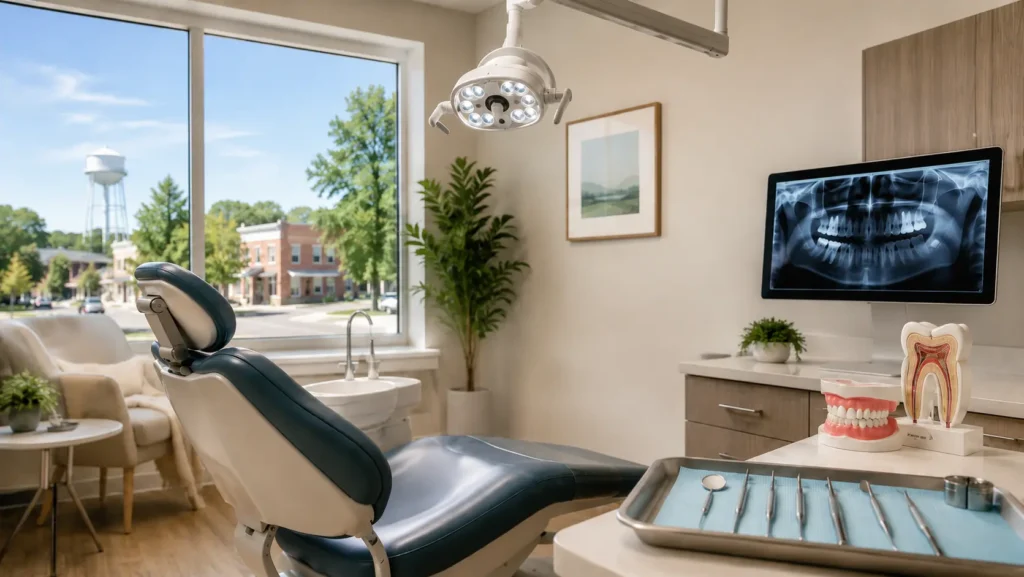
Dental emergencies rarely announce themselves at a convenient time. A tooth that had been vaguely sensitive for a week becomes acutely painful on a Tuesday afternoon. A crown pops off at dinner. A child takes a fall and a permanent tooth comes out with it. In those moments, the questions are immediate and practical: Is this an emergency? Who do I call? What do I do in the next thirty minutes?
This guide answers those questions for patients in Siler City and Chatham County — what qualifies as a dental emergency, what you should do before you reach the office, what the visit typically involves, and when the situation calls for an emergency room instead of a dental chair.
What Actually Qualifies as a Dental Emergency
Patients consistently underestimate dental emergencies and wait longer than they should. The reasons are understandable — it feels dramatic to call an office for a toothache, pain comes and goes and feels manageable, cost is a concern, or there is a hope that whatever is happening will resolve on its own.
Some of it does. A mild sensitivity to cold that clears up in a day or two is not an emergency. But the following situations warrant a same-day call to a dental office:
Severe or escalating tooth pain. Pain that keeps you awake, makes it difficult to eat, or is worsening rather than staying stable is not something to wait out. A tooth hurts because something is wrong, and the underlying cause — decay, infection, a crack, a dying nerve — does not improve with time.
Facial or jaw swelling. Swelling near a tooth, along the jawline, or under the eye suggests infection that may be spreading. Dental infections do not resolve without treatment. Left untreated, they can spread into surrounding tissue and, in serious cases, into the airway. Facial swelling alongside tooth pain is not a situation to monitor at home overnight.
A knocked-out permanent tooth. This is the most time-sensitive dental emergency. The chances of successfully reimplanting the tooth drop significantly after 30 minutes outside the socket. The American Dental Association advises keeping the tooth moist and getting to a dentist immediately — specific instructions on handling the tooth are in the FAQ section below.
A broken tooth with sharp edges or visible internal structure. A tooth that has broken significantly — particularly one with sharp edges cutting the tongue or cheek, or one where the inner pink pulp is exposed — needs evaluation quickly. The exposed pulp is vulnerable to infection.
A lost crown or filling with pain or sensitivity. A crown or filling that has come out leaves the tooth structure underneath unprotected. If there is pain or significant sensitivity when that tooth is exposed to temperature or pressure, it should be seen promptly. If it fell out and the tooth is not sensitive, it is still worth calling to get a replacement scheduled within a few days.
A bump or pimple on the gum near a tooth. This is a common sign of a dental abscess — a pocket of infection at the root of the tooth. It is easy to overlook because it often does not hurt as much as patients expect. Do not overlook it. An abscess needs treatment, not monitoring.
Pain that has been coming and going for more than a few days. Intermittent pain feels less urgent than constant pain, but it is not less significant. A tooth that hurts, quiets down, and hurts again is almost always dealing with an ongoing problem. In some cases the pain eventually stops entirely — not because the tooth healed, but because the nerve died. That quiet period is often followed by more serious symptoms. Intermittent pain that has been present for more than three or four days deserves evaluation.
When to Go to the Emergency Room Instead
A dental office is the right destination for most dental emergencies. An emergency room is the right destination when the situation involves the airway, the breathing, or systemic signs of severe infection.
Go to the ER if you have difficulty breathing or swallowing, swelling that is spreading rapidly into your neck, a fever above 101°F alongside significant facial swelling, dental trauma involving broken facial bones, or bleeding from the mouth that will not stop after sustained pressure.
For everything else — tooth pain, abscess without airway involvement, broken teeth, lost restorations, dental trauma that does not involve broken bones — a dental office is where the underlying problem can actually be treated. StatPearls notes that dental infections commonly prompt emergency treatment because of severe pain or swelling, and an ER visit in those cases typically results in pain medication and antibiotics without addressing the source of the infection. The relief is temporary. The dental visit is still necessary.
What Happens at an Emergency Dental Appointment
For patients who have not had an emergency dental visit before, knowing what to expect can make calling feel less daunting.
The appointment starts with a focused clinical assessment. The dentist examines the area of concern, asks about symptom history — how long, how severe, what makes it better or worse, whether there was any trauma — and takes targeted X-rays if needed to see what is happening at and below the gumline. The goal in those first minutes is to identify what is causing the problem so the response is directed at the right source.
From there, emergency treatment addresses the immediate issue. That might mean relieving pressure from an infected tooth, smoothing a sharp broken edge, placing a sedative dressing to calm an exposed nerve, performing an emergency extraction if the tooth cannot be saved, cleaning and re-cementing a crown, or prescribing antibiotics and arranging follow-up care for an infection that needs staged treatment.
An emergency visit is often the beginning of a treatment sequence rather than the end of one. A tooth that needs a root canal following an acute infection gets stabilized first, then definitively treated at a subsequent appointment. A broken tooth that needs a crown gets evaluated, temporized, and then restored. The emergency visit addresses urgency; the follow-up visit addresses the long-term repair.
At O2 Dental Group of Siler City, the full range of restorative services — crowns, root canals, fillings, extractions, implants — are available in the same office, so emergency patients are not referred somewhere else for every subsequent step. That continuity matters both clinically and practically for patients managing work and family schedules in Chatham County.
Same-Day Emergency Care in Siler City
O2 Dental Group of Siler City holds same-day availability for dental emergencies whenever scheduling allows. Patients dealing with tooth pain, swelling, broken teeth, or dental injuries should call the office directly at (984) 265-1655 rather than using the online booking form — a phone call allows the team to assess urgency and get you into the right appointment slot as quickly as possible.
The office is located at 103 Food Lion Plaza in Siler City, with weekday hours designed to minimize the disruption to a working day. The practice serves patients from throughout Chatham County, including communities that have limited nearby dental access and where same-day availability in Siler City itself is meaningfully more convenient than driving to Pittsboro, Chapel Hill, or Sanford for urgent care.
If you are a new patient experiencing a dental emergency, you do not need to have established care at the office beforehand. Call, describe your symptoms, and the team will advise on next steps. Dental emergencies are not situations where you should be told to call back to schedule a new patient appointment for next week.
The Problem With Waiting
Most dental problems that become emergencies were not emergencies when they started. A cavity that reaches the nerve did not appear overnight — it progressed through stages, each of which was more treatable and less expensive than the next. A dental infection that requires extraction or hospitalization began as something a filling or a root canal could have resolved months earlier.
Patients wait for understandable reasons — cost, time, anxiety, the hope that pain will resolve. But dental problems do not improve with waiting. They stabilize at best. More commonly they progress, and the treatment required after they progress is more involved, more costly, and more uncomfortable than whatever was needed earlier.
Same-day emergency care at O2 Dental Group of Siler City is built around the recognition that the best moment to address a dental problem is as early as possible — and when a patient is calling because something has already become urgent, the second-best moment is today.
Frequently Asked Questions
What counts as a dental emergency?
Dental emergencies include severe or worsening tooth pain, visible swelling in the face or jaw, a knocked-out permanent tooth, a broken tooth with sharp edges or exposed nerve, uncontrolled bleeding from the mouth, signs of abscess such as a bump on the gum or fever alongside tooth pain, and dental trauma from an injury. If you are unsure whether your situation qualifies, call the office — it is always better to ask than to wait through warning signs.
Does O2 Dental Group in Siler City offer same-day emergency appointments?
Yes. O2 Dental Group of Siler City offers same-day emergency dental appointments whenever scheduling allows. Patients with tooth pain, broken teeth, swelling, or dental injuries should call the office directly at (984) 265-1655 rather than booking online so the team can assess urgency and get you in as quickly as possible.
What should I do if a permanent tooth gets knocked out?
Pick the tooth up by the crown — the white biting surface — not the root. If it is dirty, rinse it gently with clean water but do not scrub it. Try to place it back in the socket if possible. If you cannot, keep it moist by placing it between your cheek and gum, in a cup of milk, or in a tooth preservation kit. Get to a dentist immediately — ideally within 30 minutes. The faster you are seen, the better the chance the tooth can be saved. Call O2 Dental Group of Siler City at (984) 265-1655 on your way.
Should I go to the emergency room for a dental emergency?
Go to the emergency room if you have difficulty breathing or swallowing, swelling spreading into your neck, fever above 101°F with significant facial swelling, dental trauma involving broken facial bones, or uncontrolled bleeding. For tooth pain, abscesses without airway involvement, broken teeth, and most other dental emergencies, a dental office is the right destination — an ER will typically provide pain relief and antibiotics without treating the underlying dental problem.
My tooth has been hurting on and off for weeks. Is that an emergency?
Intermittent tooth pain that keeps returning is a signal worth acting on, not waiting out. Pain that comes and goes often means a cavity, crack, or infection that is progressing. In some cases, pain that was sharp becomes dull or disappears entirely as the nerve dies — which can feel like improvement but is actually the problem getting worse. Any tooth pain that has been present for more than a few days, interferes with eating or sleeping, or is escalating in any way should be evaluated promptly.
What dental emergency services does O2 Dental Group Siler City offer?
O2 Dental Group of Siler City handles toothache evaluation and relief, broken or chipped tooth repair, lost filling or crown replacement, dental abscess treatment, knocked-out tooth reimplantation, dental trauma assessment, and urgent restorative care. Follow-up treatment including crowns, root canals, fillings, and extractions is also available at the same office so emergency patients are not left with temporary measures and no clear path forward.
Dealing With a Dental Emergency in Siler City?
Call O2 Dental Group of Siler City directly. Describe your symptoms and the team will advise on urgency, walk you through any immediate steps to take before arriving, and get you into the earliest available appointment.
O2 Dental Group of Siler City
103 Food Lion Plaza
Siler City, NC 27344
(984) 265-1655
SC@o2smiles.com
Monday–Thursday: 8:00 AM – 5:00 PM

 English