
Most people don’t ignore a cavity on purpose. They hope the sensitivity will pass. They start chewing on the other side. They tell themselves they’ll schedule something next month. That pattern is almost never about carelessness — it’s usually about being busy, anxious about treatment, or waiting for the tooth to feel bad enough to justify the trip.
The problem is that cavities don’t work that way. A cavity can stay quiet for months — causing little or no discomfort — while continuing to advance inside the tooth. By the time it actually hurts, the treatment you needed last season may no longer be on the table.
This guide walks through exactly what happens inside an untreated tooth over time, when the window for a simple fix closes, and what signs mean you need to call today rather than schedule for next month.
In this guide
- The four stages of untreated decay
- Why pain is a poor warning system
- When a filling stops being enough
- Why some cavities progress faster than others
- Signs a cavity has become a dental emergency
- When an untreated cavity leads to extraction
- Frequently asked questions
The Four Stages of Untreated Tooth Decay
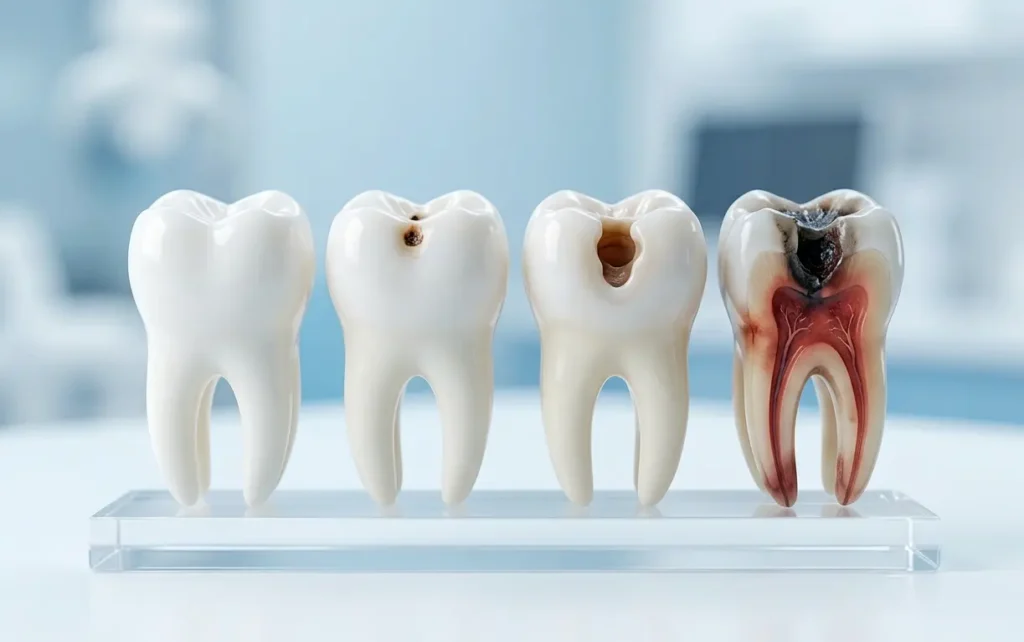
Decay doesn’t jump from “small cavity” to “dental emergency” overnight. It follows a predictable progression — and the earlier you intervene, the simpler the treatment stays.
| Stage | What’s happening | Typical symptoms | Treatment at this stage |
| 1. Enamel decay | Acid erosion begins dissolving the outer tooth surface | Usually none | Small filling or remineralization |
| 2. Dentin involvement | Decay penetrates the softer layer beneath enamel | Sensitivity to cold, sweets, or pressure | Filling — may be larger |
| 3. Pulp involvement | Decay reaches the nerves and blood vessels inside the tooth | Persistent or throbbing pain, lingering sensitivity | Root canal to save the tooth |
| 4. Abscess | Infection spreads beyond the tooth root | Swelling, fever, radiating pain, bad taste | Urgent treatment — possible extraction |
The critical thing to understand: each stage can exist without the previous one causing obvious pain. A tooth can move from Stage 1 to Stage 2 — and sometimes into Stage 3 — before a patient ever notices something is wrong.
Why Pain Is a Poor Warning System for Cavities
This is the part most people find genuinely surprising. The assumption is that a tooth will “tell you” when something is wrong. In practice, it often doesn’t — at least not early enough to matter.
The National Institute of Dental and Craniofacial Research is clear on this: early tooth decay frequently causes no symptoms at all. The enamel — the outer shell of the tooth — has no nerve endings. Decay can work through that layer entirely without producing any sensation.
Pain typically becomes noticeable once decay has moved into the dentin, where microscopic tubules connect to the nerve. By that point, the cavity is no longer in its earliest, easiest-to-treat stage. And when pain becomes significant — throbbing, constant, or waking you up — it usually means the nerve itself is involved, which changes the treatment conversation entirely.
The practical takeaway: Waiting until a tooth hurts is not the same as waiting until a tooth needs treatment. The cavity is working on its own schedule, independent of yours. The only way to know where it actually stands is an examination with current imaging.
When a Filling Stops Being Enough
For most patients, the real question isn’t whether a cavity exists. It’s whether they’re still in “filling territory” — or whether they’ve drifted past it.
A dental filling works when decay is confined to the enamel and dentin and hasn’t reached the pulp. It removes the decayed material, replaces it with composite resin or another material, and restores the tooth to normal function. It’s typically a single appointment, takes less than an hour, and involves minimal recovery.
Once decay reaches the pulp — the inner chamber containing the tooth’s nerves and blood supply — a filling can no longer address the problem. The infected tissue inside the tooth needs to be removed, the canals cleaned and sealed, and the tooth usually capped with a crown. That’s root canal treatment, and while it sounds more serious, it’s generally the procedure that saves a tooth that would otherwise need to come out.
The line between these two outcomes isn’t always visible from the outside. That’s what makes timing so consequential. A cavity that gets addressed while still in dentin stays a filling. The same cavity addressed six months later — after symptoms develop and the patient finally books an appointment — may now require root canal treatment and a crown.
The cost difference is significant. A composite filling typically costs a fraction of a root canal and crown combined. Beyond money, root canal treatment involves multiple appointments, a longer recovery, and more anesthesia. The simpler outcome isn’t just easier — it’s objectively the better deal in every direction.
Why Some Cavities Progress Faster Than Others
Patients often compare notes. A friend waited eighteen months and only needed a small filling. Someone else was diligent about checkups and still needed a root canal. These comparisons feel relevant, but they’re rarely useful — because cavity progression is individual.
Several factors accelerate decay:
- Dry mouth (xerostomia): Saliva neutralizes acid and helps remineralize enamel. Without adequate flow, decay accelerates significantly. Many common medications reduce saliva production.
- Diet high in sugar or acid: Frequent exposure to sugar feeds the bacteria that produce cavity-causing acid. Sipping sugary drinks throughout the day is particularly damaging.
- Enamel quality: Some patients have naturally thinner or softer enamel, making decay easier to establish and faster to progress.
- Tooth location and anatomy: Back teeth with deep grooves are harder to clean and more cavity-prone. Decay between teeth is harder to detect without X-rays.
- Existing dental work: Decay around the margins of old fillings or beneath cracked crowns can be difficult to detect and may progress unnoticed.
NIDCR notes that tooth decay begins with repeated mineral loss — once the structure starts to weaken, the process accelerates. This is why early-stage cavities caught at a routine visit are so much easier to treat than cavities caught once symptoms develop.
Signs a Cavity Has Become a Dental Emergency
Not every untreated cavity becomes an emergency. But some do — and when that happens, the situation changes quickly.
These are the signs we treat as urgent, because they suggest the problem has moved past ordinary decay into infection or structural failure:
- Swelling in the gums, cheek, or jaw
- Pain that is constant or throbbing rather than triggered by a stimulus
- Pain that wakes you up at night
- Fever or chills
- A persistent bad taste in the mouth
- Difficulty opening the jaw or swallowing
- A visible pimple-like bump on the gum near a painful tooth
The Cleveland Clinic notes that untreated deep cavities can lead to abscess formation, with pain that may radiate into the face or jaw. A dental abscess is not a problem that waits comfortably — and in rare cases, untreated oral infections can spread to surrounding tissue.
O2 Dental Group offers same-day emergency appointments at all locations for situations like these. If you’re experiencing any of the symptoms above, call your nearest location directly rather than scheduling online — we prioritize urgent cases.
Experiencing tooth pain, swelling, or signs of infection?
Don’t wait it out. Same-day emergency appointments are available.
Request a Same-Day Appointment
When an Untreated Cavity Leads to Extraction
Extraction is never the first choice. At O2 Dental Group, we preserve teeth whenever preservation still makes clinical sense. But there are circumstances where decay has progressed so far — structurally or through infection — that saving the tooth is no longer the right call.
When a tooth is extracted, the work doesn’t end there. The missing space needs to be addressed to prevent neighboring teeth from shifting and bone from resorbing. For most patients that means evaluating options like dental implants, a bridge, or a partial denture.
In cases involving multiple severely decayed teeth, patients sometimes face more complex conversations around full-arch restoration. These are not the typical outcome of a single neglected cavity — but they are the real end of the road when multiple teeth are left untreated for extended periods.
The path from “small cavity” to “extraction” is not inevitable. It requires time, continued neglect, and usually a combination of unfavorable factors. But it is a real path — and the only reliable way to avoid it is early treatment.
The Practical Answer to How Long a Cavity Can Wait
The direct answer: long enough to become more expensive, more involved, and more uncomfortable than it needed to be.
An untreated cavity does not stabilize. It does not get smaller. It continues to progress — sometimes slowly, sometimes quickly, depending on the factors discussed above. The tooth doesn’t signal danger reliably. The decay doesn’t wait politely.
The earlier a cavity is caught and treated, the more options the patient has and the simpler the treatment stays. That’s not a sales pitch — it’s just the consistent pattern we see across thousands of patients at every stage of decay.
If something in your mouth feels different — a tooth that’s more sensitive than it used to be, a spot that catches food, a shadow you’ve been meaning to ask about — that’s worth a conversation sooner rather than later. Early evaluation almost always reveals either reassuring news or manageable news. Neither outcome requires more time than you’re spending wondering.
Frequently Asked Questions
How long can a cavity go untreated before it starts to hurt?
Sometimes months, sometimes longer. Early cavities often cause no pain at all — the National Institute of Dental and Craniofacial Research notes that early tooth decay frequently has no symptoms. Pain typically appears once decay has moved into deeper tooth layers, which means the cavity may already need more than a filling by the time it becomes uncomfortable.
Can a cavity progress even if it doesn’t hurt?
Yes. Pain is not a reliable indicator of cavity severity. Many cavities advance through the enamel and into the dentin — sometimes into the pulp — while causing little or no discomfort. A tooth can feel mostly normal while underlying decay continues to grow.
At what point does a cavity require a root canal instead of a filling?
Once decay reaches the pulp — the innermost layer containing the tooth’s nerves and blood vessels — a filling is no longer sufficient. Root canal treatment removes the infected tissue, seals the canals, and saves the tooth from extraction. Signs this stage has been reached include persistent pain, sensitivity that lingers after the trigger is removed, or spontaneous aching with no obvious cause.
Can an untreated cavity turn into an abscess?
Yes. When decay reaches and infects the pulp and is left untreated, bacteria can spread beyond the tooth root and form an abscess. The Cleveland Clinic notes that untreated deep cavities can cause abscess formation with pain that may radiate into the face or jaw, along with swelling, fever, and a bad taste in the mouth. An abscess requires urgent treatment.
Why do some cavities get worse faster than others?
Cavity progression varies significantly by patient. Dry mouth, high sugar intake, poor oral hygiene, enamel quality, and the location of the decay all affect how quickly it advances. NIDCR explains that decay begins with repeated mineral loss — once tooth structure weakens, progression tends to accelerate.
What are the warning signs that a cavity has become an emergency?
Swelling in the gums, cheek, or jaw; constant or throbbing pain; pain that wakes you at night; fever; a bad taste in the mouth; or difficulty chewing or swallowing. These symptoms suggest infection or abscess and typically require same-day dental care. Call O2 Dental Group directly — don’t wait for a scheduled opening.
Will waiting always make cavity treatment harder?
Almost always. A cavity caught in early enamel decay is typically a single-appointment filling. The same cavity left to progress may eventually require a root canal, crown, or extraction followed by an implant. Treatment becomes more involved, more expensive, and more time-consuming the longer decay continues unchecked.
Can O2 Dental Group see cavity-related emergencies the same day?
Yes. O2 Dental Group offers same-day emergency appointments at all locations, including Saturday availability at select offices. If you’re experiencing severe pain, swelling, or signs of infection, call your nearest location directly for fastest scheduling.
Related Pages
- Emergency Dental Care — O2 Dental Group
- Fillings & Restorative Services
- Dental Implants
- Financing & Insurance Options
- Request an Appointment
- More from the O2 Dental Group Blog

Add O2 Dental Group to your Preferred Sources
