
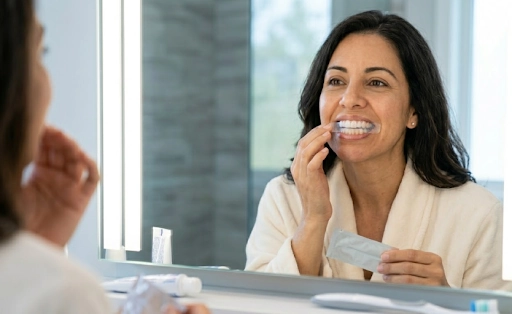
Whitening strips are everywhere — drugstore endcaps, Amazon listings, social media ads with dramatic before-and-after photos. And at $30 to $60 a box, they’re tempting. But do they actually work? And more importantly, are they the right choice for your teeth?
The honest answer is: it depends. At O2 Dental Group, we get questions about whitening all the time from patients across North Carolina — and we’d rather give you the real picture than a sales pitch. So here’s a straightforward breakdown of how whitening strips work, where they fall short, and when professional whitening is worth it.
The Science Behind Whitening (All of It, OTC or Professional)
Whether you’re using a $35 box from the drugstore or getting an in-office treatment at O2 Dental Group, the active ingredient doing the heavy lifting is the same: hydrogen peroxide (or carbamide peroxide, which breaks down into hydrogen peroxide).
Here’s how it works: when the peroxide gel contacts your teeth, it releases oxygen molecules that penetrate the porous structure of your enamel and dentin. Those oxygen molecules break apart the “chromogens” — the pigment compounds responsible for staining from coffee, wine, tea, and the natural aging of your teeth.
The key variables that determine how well this works? Concentration and contact time.
There are also two types of stains to understand:
- Extrinsic stains sit on or near the surface of the enamel. Whitening strips can do a decent job on these.
- Intrinsic stains are deeper, within the tooth structure itself. Most over-the-counter strips don’t have the concentration or contact time to reach these effectively — which is why some people whiten for weeks and still see a yellowish core to their teeth.
Where Whitening Strips Fall Short
Strips aren’t a scam — but they do have real limitations worth knowing before you commit.
Lower peroxide concentration. Drugstore strips typically use 3% to 10% peroxide, which is intentionally lower to be safe for unsupervised use. That means slower results and limited effectiveness on deeper staining.
Uneven coverage. Strips are flat. Your teeth aren’t. The result is often what dentists call the “piano key” effect — the flat front surfaces whiten while the edges and spaces between teeth stay yellowish.
Saliva dilution. Because strips aren’t sealed to your teeth, saliva can leak in, diluting the gel and sometimes washing it onto your gums — which can cause irritation.
They’re not for everyone. This is the big one. Applying whitening chemicals to your teeth without knowing the current state of your oral health can cause real problems:
- If you have an undetected cavity, peroxide can seep into it and reach the nerve, causing severe pain
- If you have receding gums, peroxide can hit exposed root surfaces (which have no enamel protection), causing intense sensitivity
- If you over-use strips, you can thin the mineral structure of your enamel, making teeth look translucent or grayish at the edges — a hard problem to reverse
- If you have crowns, veneers, or composite fillings, bleach won’t change their color at all, which can leave your smile looking uneven
The American Dental Association recommends that whitening is safest and most effective when it’s overseen by a dentist — not because professional whitening is the only option, but because knowing the condition of your teeth before you start makes a real difference.
How Professional Whitening Is Different
When you come in for a whitening treatment at O2 Dental Group, you’re not just getting a stronger version of what’s in the box. The whole approach is different.
It starts with a screening. Before any whitening, we check for cavities, gum issues, and anything else that could make the process uncomfortable or unsafe. This step alone prevents a lot of the sensitivity problems people run into with DIY whitening.
Custom-fit trays (for take-home kits). Instead of a flat strip trying to conform to your curved teeth, professional take-home kits use trays molded to your exact tooth anatomy. The gel reaches the contours and crevices that strips miss — which means more even, consistent results.
Higher concentration, safely applied. Professional systems can use concentrations up to 25% to 40% peroxide. In-office, a protective “liquid dam” is placed over your gums before the gel is applied, so the high-strength bleach contacts your teeth without irritating the surrounding tissue.
Desensitizing agents. Professional whitening gels typically include potassium nitrate or fluoride to reduce sensitivity during and after treatment — a major advantage if you’ve tried strips before and found them uncomfortable.
Light-activation (for in-office treatments). Many in-office protocols use specific wavelengths of light to accelerate the peroxide, breaking down stains faster and allowing for a dramatic result — often 5 to 8 shades brighter — in a single 60-minute visit.
How to Keep Your Results Lasting Longer
Whitening — professional or otherwise — isn’t permanent. But with a few simple habits, you can make your results last much longer:
Watch what you eat and drink for the first 48 hours. Right after whitening, your enamel pores are temporarily more open, which makes your teeth more susceptible to re-staining. Avoid coffee, red wine, dark sauces, and berries for two days.
Use a straw. When you do drink coffee or iced tea, a straw keeps the liquid away from the front surfaces of your teeth.
Touch up periodically. Professional patients usually receive custom trays they can use at home for a quick 15-minute refresh every few months. It’s a lot easier (and cheaper) than starting from scratch.
Keep up with your cleanings. Regular professional cleanings at O2 Dental Group remove the surface buildup that dulls your smile between whitening sessions. It’s the best foundation for keeping your teeth looking bright.
Your Questions, Answered
Can whitening strips damage my enamel?
When used exactly as directed, they’re generally safe for healthy teeth. The problem is overuse — using them more often than recommended or for longer than advised can lead to enamel thinning and increased porosity over time.
Do whitening strips work on crowns, veneers, or fillings?
No. Bleach only affects natural tooth structure. Porcelain and composite resin don’t respond to peroxide, which means whitening your natural teeth can leave your restorations looking darker by comparison. This is one of the main reasons we recommend a dental check before whitening.
How long does it take to see results?
With OTC strips, you might notice a slight difference after 7 to 10 days of consistent use. With professional in-office whitening at O2 Dental Group, most patients see a 5 to 8-shade improvement in a single one-hour appointment.
Why do my teeth feel sensitive after whitening strips?
Peroxide temporarily opens up the microscopic tubules in your enamel that connect to the nerves. Professional gels include compounds like amorphous calcium phosphate (ACP) to buffer this effect. If strip sensitivity is an issue for you, that’s a great reason to explore professional options.
Are whitening strips worth the money?
For mild surface staining and healthy gums, they’re a reasonable starting point. But if you have deeper staining or want a more dramatic, even result, the cost of buying box after box often ends up exceeding the cost of a single professional treatment — with much less predictable results along the way.
The Bottom Line
Whitening strips can work — but they work best on surface stains, healthy teeth, and people with realistic expectations. For deeper staining, uneven results, or anyone who’s had sensitivity issues in the past, professional whitening is a smarter, safer, and often more cost-effective path.
At O2 Dental Group, we offer professional whitening options at all of our North Carolina locations — Raleigh, Durham, Wilmington, Fayetteville, Southern Pines, Siler City, and more. We’ll start with a quick assessment of your teeth to make sure whitening is the right fit and recommend the approach that makes the most sense for your smile and your budget.
Curious what a few shades brighter could look like for you? Schedule a whitening consultation at O2 Dental Group — we’ll give you an honest answer and a plan that actually delivers.
 Spanish