
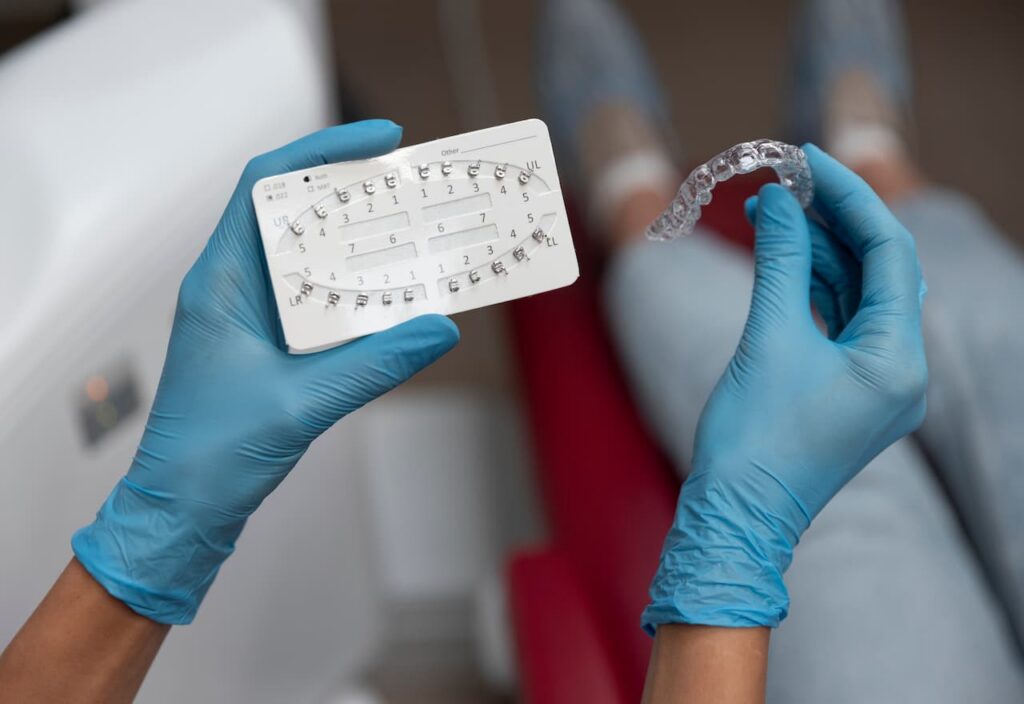
The journey to a perfect smile is a transformative milestone, yet it often begins with a difficult question: Invisalign vs. braces? Deciding how to realign your teeth is about more than just aesthetics; it is a choice that affects your daily comfort, your self-confidence, and your long-term oral health.
Whether you are a professional concerned about your “corporate image” or a parent looking for the most reliable path for your child, understanding the structural and lifestyle differences between these two powerhouses is essential. In this expert-led comparison, we break down the engineering behind both systems to help you choose the path that best fits your life.
The Aesthetic Evolution: Discretion vs. Durability
The most immediate factor in the Invisalign vs. braces decision is how you look during the process. For many, the “invisible” nature of modern orthodontics has completely removed the stigma of straightening teeth as an adult.
The Invisible Advantage
Invisalign uses a series of clear, medical-grade thermoplastic aligners that are virtually undetectable. This is the ultimate choice for those who want their smile to transform “behind the scenes.” There are no wires to catch the light and no brackets to interfere with your facial profile.
The Resilience of Traditional Braces
While traditional braces are visible, modern orthodontics has made them sleeker and smaller than ever. You also have the option of ceramic (clear) brackets, which offer a middle ground between the strength of metal and the discretion of Invisalign. For many, the “visibility” of braces is a small price to pay for the guaranteed, 24/7 movement they provide.
Scientific Insight: Primary Stability Research
According to a landmark study published in PubMed Central (PMC6343314), researchers compared the “primary stability” (the initial firmness of the implant upon placement) between these two materials.
Reliability and Clinical Precision: Which Works Better?
When we analyze Invisalign vs. braces from a clinical perspective, we have to look at the complexity of the “case.” Not all teeth move the same way, and some corrections require more mechanical leverage than others.
Why Braces Win on Complexity
Traditional braces are physically bonded to each tooth. This allows the orthodontist to apply precise, multi-directional force. If you have severely rotated teeth, large gaps, or a complex “vertical” bite issue, braces are often the most reliable tool. They don’t rely on the patient to remember anything—they are always working.
The Innovation of Invisalign
Invisalign has closed the gap significantly in recent years. Using proprietary SmartTrack material and “attachments” (tiny, tooth-colored bumps placed on the teeth), Invisalign can now handle many cases that were previously only treatable with metal. However, the reliability of Invisalign depends entirely on “compliance”—if the aligners aren’t in your mouth for 22 hours a day, the biology of the movement simply won’t happen.
The Maintenance Factor: Daily Life with Orthodontics
Lifestyle is where the Invisalign vs. braces debate becomes personal. How much are you willing to change your daily routine to achieve that perfect alignment?
Invisalign: Freedom with Responsibility
The greatest benefit of Invisalign is that the aligners are removable. You can eat whatever you want—corn on the cob, apples, and sticky treats are all on the menu. Brushing and flossing are exactly the same as always because there are no wires to navigate. The trade-off? You must brush your teeth every single time you eat before putting the aligners back in to avoid trapping sugar and bacteria against your enamel.
Braces: Constant Care
With traditional braces, your diet must be more “selective” to avoid breaking brackets. Maintenance requires specialized tools like floss threaders or water flossers to clean between the hardware. However, there is a certain “set it and forget it” peace of mind; you never have to worry about losing an aligner at a restaurant or forgetting to put it back in after a long dinner.
Comfort and the “Adjustment Period”
No matter which path you choose in the Invisalign vs. braces journey, your teeth are being physically moved through bone. This involves an adjustment period.
- Soft Tissue Comfort: Invisalign is generally smoother on the cheeks and lips. There are no sharp metal edges to cause “canker sores” or irritation.
- Pressure Cycles: Braces exert a constant, steady pressure that is adjusted once every 4–6 weeks. Invisalign exerts a “new” pressure every 1–2 weeks when you switch to a fresh set of trays.
- Speech Impact: Some Invisalign users notice a slight lisp for the first few days as the tongue adjusts to the thickness of the plastic, whereas braces generally don’t affect speech patterns.
Cost and Treatment Timeline
It is a common myth that Invisalign is always more expensive. In the modern market, the price gap for Invisalign vs. braces has narrowed significantly.
Investment Breakdown
The cost of both treatments is usually determined by the complexity of the movement and the duration of the treatment. Many insurance plans now cover Invisalign at the same rate as traditional braces. On average, Invisalign treatment can sometimes be faster for minor crowding, while braces are more efficient for long-term, structural jaw alignment.
Treatment Duration
- Invisalign: Typically 6 to 18 months.
- Braces: Typically 18 to 24 months.
- Note: These timelines depend heavily on how well the patient follows the orthodontist’s instructions.
FAQ: Clearing the Confusion
Is Invisalign more painful than braces?
Most patients report that Invisalign is “uncomfortable” during the first two days of a new tray, but it lacks the sharp irritation that metal brackets can cause to the inner lips.
Can I switch from braces to Invisalign halfway through?
In many cases, yes. However, this often increases the total cost of treatment as you are paying for two different systems and sets of laboratory fees.
Does Invisalign stain?
The aligners themselves can stain if you drink coffee, tea, or red wine while wearing them. This is why it is vital to remove them for anything other than plain water.
Are braces better for teenagers?
It depends on the teenager. While many teens prefer the look of Invisalign, “compliance” is a major factor. If a teen is likely to lose the trays or forget to wear them, traditional braces are a much safer investment.
How often do I need check-ups?
Braces usually require a visit every 4 to 6 weeks for adjustments. Invisalign often allows for longer gaps (6 to 10 weeks) since you are provided with several sets of trays to change at home.
Your Path to a Confident Smile
In the final assessment of Invisalign vs. braces, the “best” option is the one that you will actually stick with. Braces offer unmatched structural reliability for complex cases, while Invisalign provides a level of freedom and aesthetics that was once unimaginable.
Your smile is a lifetime asset. Whether you are in a bustling city center or a quiet suburb, the first step is a professional consultation to scan your teeth and see a digital preview of your future results. Don’t let indecision hold you back from the confidence you deserve.
Are you ready to see your future smile? Contact our orthodontic specialists today. On O2 Dental Group we offer both advanced Invisalign technology and the latest in discreet traditional braces. Let’s map out the most efficient, comfortable, and beautiful path to your new smile.
 Spanish