
Dental Bridges in Raleigh, NC
Caring for an Implant-Supported Bridge
Learn how to properly care for your implant-supported bridge to keep your implants healthy and your restoration functioning for years to come. This video demonstrates effective cleaning techniques, recommended hygiene tools, and daily maintenance tips to help prevent plaque buildup and protect the surrounding gums and implants.
Share with PatientWeighing a Dental Bridge Against Your Other Options in North Raleigh
A lost tooth pushes you into a decision, and in practice there are three routes worth taking seriously: a fixed bridge, a single dental implant, or a removable partial. Each fits a different set of circumstances, and the right pick has less to do with what’s newest and more to do with the shape of your own mouth. At O2 Dental Group of Raleigh — just off Louisburg Road near Triangle Town Center — we open every tooth-replacement visit by putting those three routes next to one another so you can see the trade-offs plainly before anyone picks up an instrument.
A bridge earns its keep by anchoring a replacement tooth, called a pontic, to the standing teeth that border the empty space. It’s fixed, so nothing clicks in and out, and the workflow behind it is one dentistry has refined for decades. For plenty of North Raleigh patients that predictability is exactly the appeal.
The Three Routes, Side by Side
| Consideration | Fixed Bridge | Single Implant | Removable Partial |
|---|---|---|---|
| How it anchors | Crowns on the two bordering teeth carry a pontic between them | A titanium post fused into the jaw carries its own crown | An acrylic-and-metal appliance clips onto remaining teeth |
| Time to finished tooth | Roughly 2 to 4 weeks | Four to seven months with healing | Two to three weeks |
| Touches the neighbors? | Yes — bordering teeth are reshaped for crowns | No — leaves adjacent teeth untouched | Rests against them but doesn’t reshape |
| Holds the jawbone? | No bone stimulation at the gap | Yes — the post preserves bone | No |
| Usual service life | Ten to fifteen years | Often decades | Five to eight years |
Where a Bridge Tends to Win
The strongest case for a bridge shows up when the bordering teeth already have problems of their own. If the teeth flanking your gap are carrying large, failing fillings or old fractures and are heading toward crowns anyway, folding them into a bridge solves several issues in a single course of treatment rather than paying for crowns and an implant as separate projects. A bridge also moves faster than an implant, which matters when a graduation, a reunion, or a family photo is on the calendar and you don’t have six-plus months of waiting ahead of you. And for patients whose bone volume is thin, or whose medications or health history make oral surgery a harder call, a bridge sidesteps the surgical piece entirely.
Where We'd Point You Toward an Implant
When the teeth on both sides of the gap are sound and haven’t needed any work, reshaping them just to carry a bridge means grinding down healthy enamel — real structure you don’t get back. In that situation a dental implant usually makes more sense, because it replaces the tooth without borrowing from its neighbors and it keeps the jawbone at the site active. Younger patients who need the result to hold up for forty or fifty years also tend to come out ahead with an implant on the long-run math. We’ll lay the numbers out for both and let you choose with your eyes open.
Bridge Styles We Build
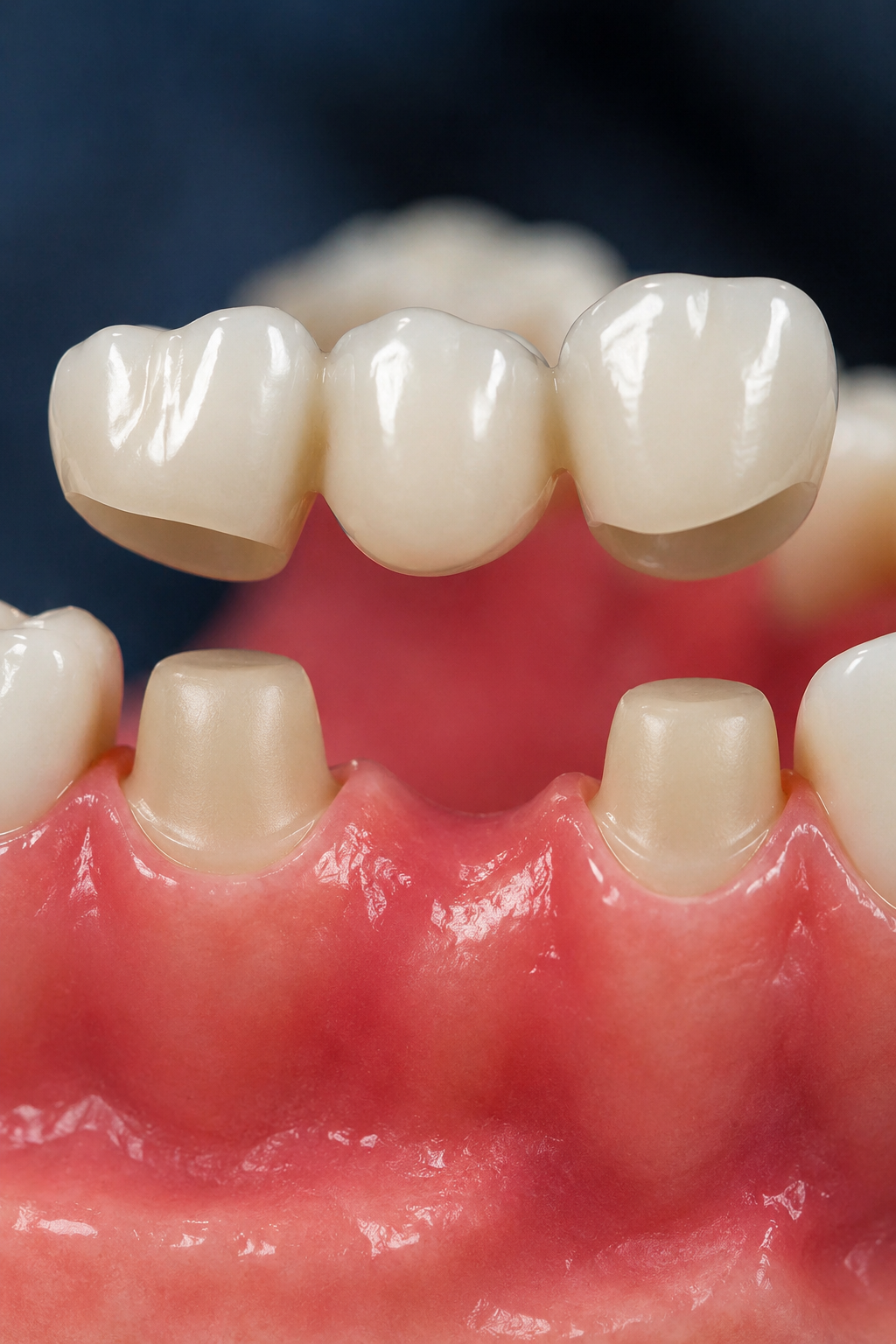
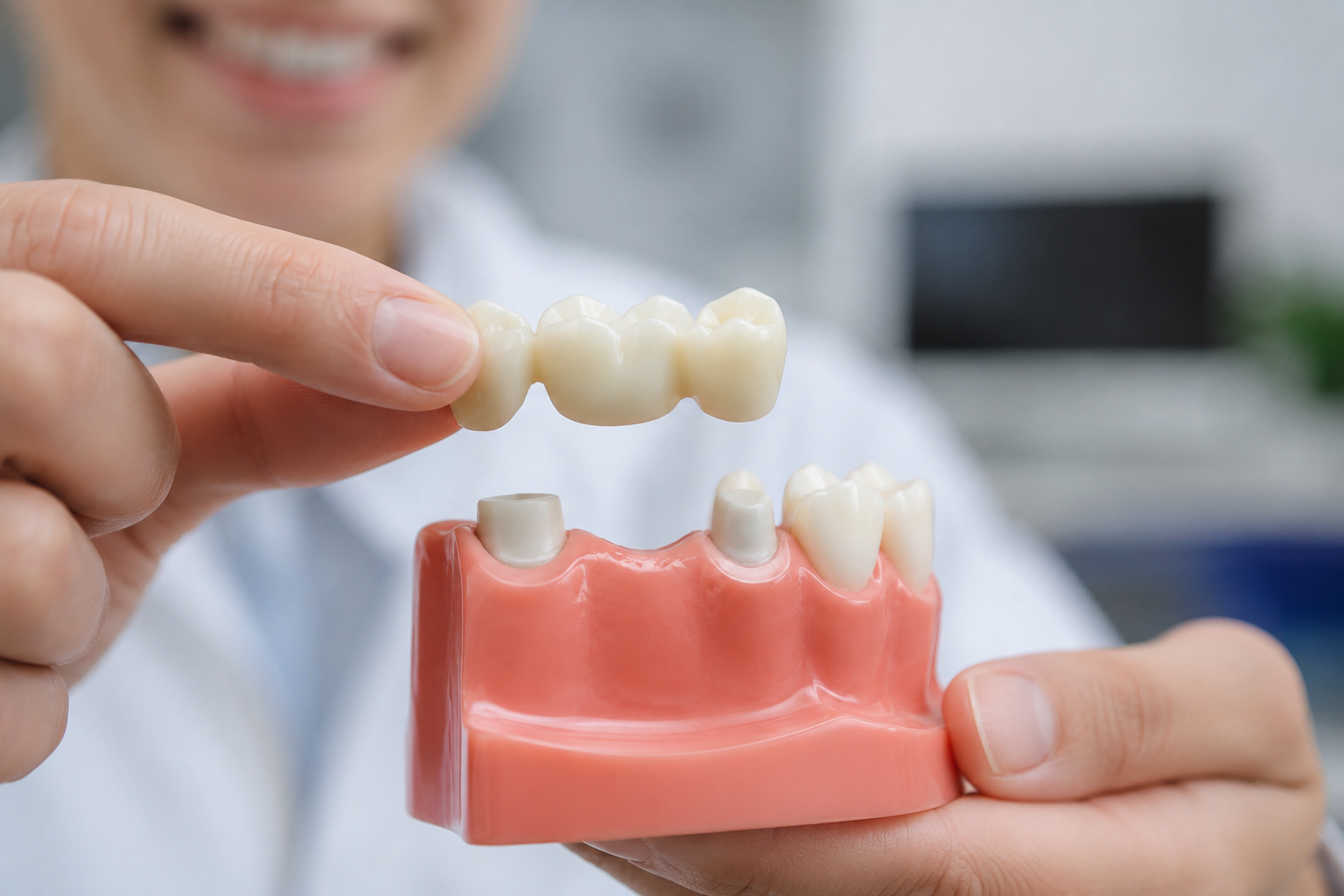
Most Raleigh cases call for the everyday design that caps the two teeth on either side of the space and hangs a pontic between them. When several teeth in a row are gone, an implant-supported bridge lets a pair of posts carry a span of three or four teeth, far more conservative than one implant per tooth. A cantilever version leans on one anchor tooth, handy where only a single strong neighbor stands beside the gap. And a Maryland bridge, which bonds a thin wing behind the neighboring teeth rather than capping them, is our most tooth-sparing route for one missing front tooth.
How This Has Played Out in Raleigh (identities protected)
A Wakefield commuter who’d been putting it off. He’d lived with a gap where a lower molar used to be for the better part of three years, and the two teeth beside it were both cracking around ancient silver fillings. Rather than crown those teeth today and chase an implant later, we built one three-unit bridge that crowned both neighbors and filled the space in a single stretch of appointments. He was finished inside a month and walked out with three restorations for the price of one plan.
A Falls of Neuse retiree with a partial she’d stopped wearing. Four lower teeth had been missing long enough that her removable partial mostly sat in a drawer. Placing four separate implants would have meant grafting the thinned ridge first, which she wanted no part of. We set two implants at the strong points of the arch and spanned a four-unit fixed bridge between them — no partial, no extensive grafting, and a bite she actually uses again.
A North Hills professional with a wedding six weeks out. An upper front tooth was lost to a fall, and an implant’s healing window would have run well past the ceremony. Her bordering teeth were healthy, which normally argues for an implant, but the calendar argued louder. We talked the trade-off through honestly, she chose a front bridge with full information, and the permanent restoration was seated with more than a month to spare.
What the Appointments Actually Involve
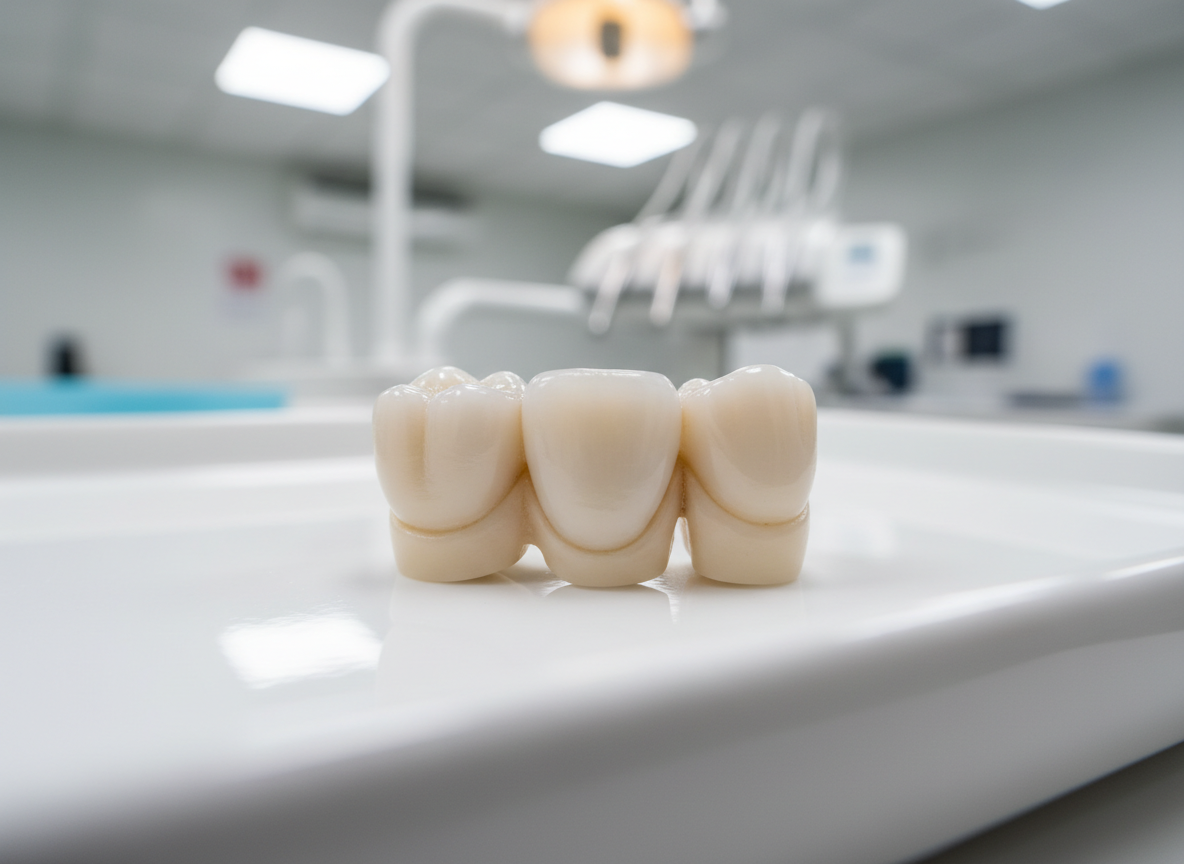
A traditional bridge unfolds across two or three visits. First comes planning and imaging, usually about an hour. Next is the preparation visit, where the bordering teeth are shaped and a digital or putty impression is captured; you leave wearing a temporary. The lab then fabricates your permanent bridge over roughly 2 to 3 weeks. At the final visit we remove the temporary, check the fit and your bite, and cement the finished bridge. Implant-supported spans run longer — 4 to 7 months — because the posts have to knit into the bone before they can carry a chewing load.
What Bridges Cost in Raleigh
A traditional fixed bridge at our Raleigh office generally lands between $2,500 and $6,000, driven by how many units are involved, the material chosen, and how complex the case is. The common single-gap, three-unit bridge typically falls between $3,000 and $4,500. Implant-supported bridges sit higher because of the surgical component — a two-implant, four-unit span usually totals between $12,000 and $18,000, and it buys markedly longer service life and preserved bone. Most plans treat bridges as major restorative care and cover around half after your deductible, up to the annual cap; we confirm your exact benefits before we begin. For the out-of-pocket share, we offer the O2 Advantage Plan, CareCredit, and Sunbit.
Raleigh Dental Bridge Questions We Hear Often
Which costs less, a bridge or an implant?
For a single missing tooth, a traditional bridge is usually the lower up-front number. Over a lifetime the picture narrows, since bridges are typically redone every 10 to 15 years while implants often last decades. We give you both the today number and the long-run number.
Do the teeth beside the gap really have to be filed down?
For a traditional bridge, yes — the two bordering teeth are shaped to seat crowns. That’s the main reason we steer patients with perfectly healthy neighbors toward an implant instead, and patients whose neighbors already need crowns toward the bridge.
Can I still get a bridge if the tooth's been gone for years?
Often, but not always. Long gaps let the bone shrink and let neighboring teeth tip into the space, so we assess both at the consult and tell you whether any groundwork is needed first.
How do I keep a bridge clean underneath?
A floss threader — or a water flosser — slips under the pontic where regular floss can’t go; we coach it at seating and revisit it each cleaning.
Does dental insurance help with a bridge?
Usually, at roughly the major-restorative level — about half once the deductible is met. Coverage on implant-supported bridges varies more, so we verify yours in advance.
Neighborhoods We Serve from Our Raleigh Office
Sitting off Tin Roof Way near Triangle Town Center, our Raleigh practice is an easy drive for patients across North and Northeast Raleigh — Wakefield, Falls of Neuse, North Hills, and the Midtown corridor — plus Rolesville, Wake Forest, Knightdale, Zebulon, and Wendell out toward the county line.
Book a Raleigh Bridge Consultation
If you’re weighing a bridge against an implant or a partial, the consultation is where it gets clear. We evaluate your teeth, walk all three routes honestly, and help you land on the one that fits your timeline and budget. Reserve a time online or phone (919) 341-4160.
Schedule Today!
We look forward to meeting you. Call (919) 341-4160 or request an appointment online to set up your first visit. We’ll be in touch soon.
Monday:
Tuesday:
Wednesday:
Thursday:
Friday:
Saturday:
Sunday:
8:00am – 4:00pm
8:00am – 4:00pm
8:00am – 4:00pm
8:00am – 4:00pm
CLOSED
8:00am – 2:00pm (Every Other Saturday)
CLOSED
