
Root Canal Treatment in Raleigh, NC
“Root canal” is shorthand a lot of people use for pain itself — which is unfair to the procedure, because a root canal is what ends the pain. The fearsome reputation traces back to decades-old methods on teeth that were already badly infected. Modern endodontics is a calm, well-numbed appointment that saves a tooth you’d otherwise lose. We do it right here at our office off Louisburg Road near I-540, in-house rather than shipping you to an endodontist on the far side of the Beltline — one less thing to juggle in a full Raleigh week.
Root Canal
Learn how root canal therapy removes infected or inflamed tissue from inside a tooth to eliminate pain and save your natural tooth. This video explains why root canals are needed, what happens during treatment, and how restoring the tooth afterward helps protect it for long-term function.
Share with PatientA tooth that’s ached for days won’t settle on its own. Call (919) 341-4160 and let’s take a look before it spreads.
What's Actually Going On Inside the Tooth
Every tooth carries a thread of soft tissue at its center — the pulp, a bundle of nerves and blood vessels. Deep decay, a fracture, or one too many repairs can let bacteria in, and once the pulp is infected it has nowhere to drain inside the solid tooth, so it can’t heal. That’s the throbbing you feel, and if it’s ignored the infection eventually works into the surrounding bone. A root canal takes out that diseased pulp, scrubs and shapes the slender canals in the roots, and packs them with a stable filling called gutta-percha. You keep the tooth itself — the part that bites, the root in the bone — minus the part that was hurting.
Symptoms Worth Acting On
The standout sign is pain that over-the-counter medicine barely touches. Also watch for:
- A persistent, deep ache — often flaring after you lie down or when you press on the tooth.
- Temperature pain that lingers — a sip of coffee or cold water that keeps hurting well after you swallow.
- A gum bump or swelling — a small blister-like spot by the root that comes and goes; it flags infection down at the tip of the root.
- A single darkening tooth — one tooth shifting gray or brown, often traceable to an old injury, can signal a dead nerve.
- A heavily worked-over tooth — lots of past fillings or a large restoration that’s finally pushed the pulp past recovery.
Why “same-day emergency root canal” isn’t something we promise. It’s a common headline, but the dentistry rarely backs it up. Your first appointment is about relief — draining an abscess, antibiotics where there’s active infection, something to settle the pain — after which the canal itself is best cleaned once the tooth will hold anesthesia and the swelling has eased, typically a few days out. A canal rushed mid-infection is a canal that more often fails later. Comfortable today, treated correctly soon after, is the trade we’ll always make.
How the Appointment Goes
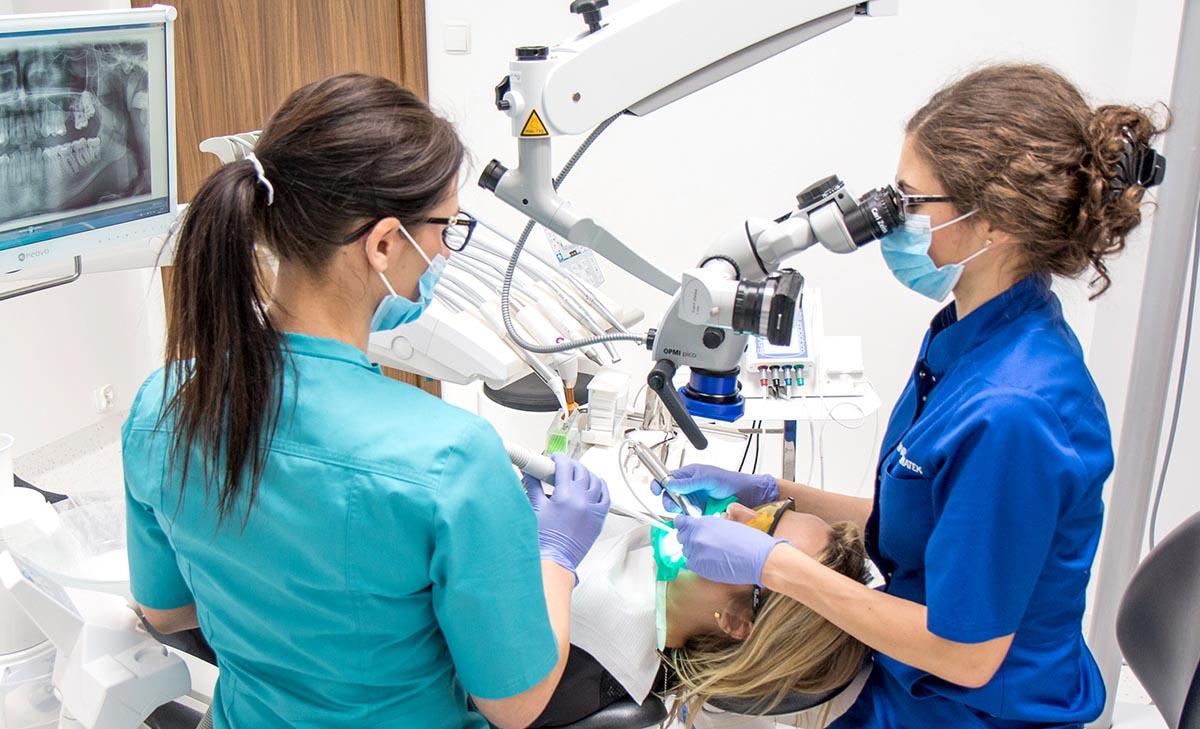
Set aside one to two appointments in the 60-to-90-minute range. The tooth is brought fully numb before we touch it — anything sharp and we top up the anesthetic instead of pressing on — and a small rubber dam walls it off. Working through one access point, we lift out the infected pulp, scrub and taper the canals, flush with a disinfecting rinse, and pack them with gutta-percha. A front tooth or bicuspid is generally a one-visit job; a molar’s extra canals can stretch it to two, with a temporary filling bridging the gap. A custom crown then goes on at a later visit, built to match your bite and shield the tooth from cracking.
Recovery
The relief tends to be immediate — the nerve that was firing is gone. Expect a day or two of tenderness that ordinary pain relievers cover. Lean on softer foods at first and don’t chew on that side until the crown is seated. From there it’s just another tooth; capped and cared for normally, treated teeth clear a 90% success rate and keep working for years.

Cost and Insurance
Here, the endodontic portion comes to between $800 and $1,800, scaled to the tooth and its canal count — a single-canal front tooth at the bottom of that span, a molar at the top. Capping it afterward with a crown adds another $1,200 to $2,000 or so. Plans generally file the procedure under major restorative work, picking up about half once your deductible clears, with crown reimbursement varying. We nail down the figures up front; whatever’s yours to cover splits into installments via CareCredit, Sunbit, and the O2 Advantage Plan.
Root Canal — Raleigh – Frequently Asked Questions
What will it run?
The canal itself is $800 to $1,800; the crown after adds $1,200 to $2,000. Insurance usually picks up roughly half of the canal as major restorative work, verified up front.
Does the procedure hurt?
Not really — numbed up, it’s on par with a deep filling, and most people leave more comfortable than they arrived.
Handled here, or sent elsewhere?
Done in our office, molars and all. Only the rare, genuinely complex case goes to a specialist, and you’d hear that at the start.
Same-day while I'm in pain?
No — we settle the pain at that first visit and do the canal a few days on, once the tooth numbs reliably.
Is a crown needed after?
Nearly always — a custom crown caps the now-brittle tooth so it holds up for the long haul.
Book a Root Canal Consultation in Raleigh
Don’t wait out a toothache. Book online or call.
Schedule Today!
We look forward to meeting you. Call (919) 341-4160 or request an appointment online to set up your first visit. We’ll be in touch soon.
Monday:
Tuesday:
Wednesday:
Thursday:
Friday:
Saturday:
Sunday:
8:00am – 4:00pm
8:00am – 4:00pm
8:00am – 4:00pm
8:00am – 4:00pm
CLOSED
8:00am – 2:00pm (Every Other Saturday)
CLOSED
