
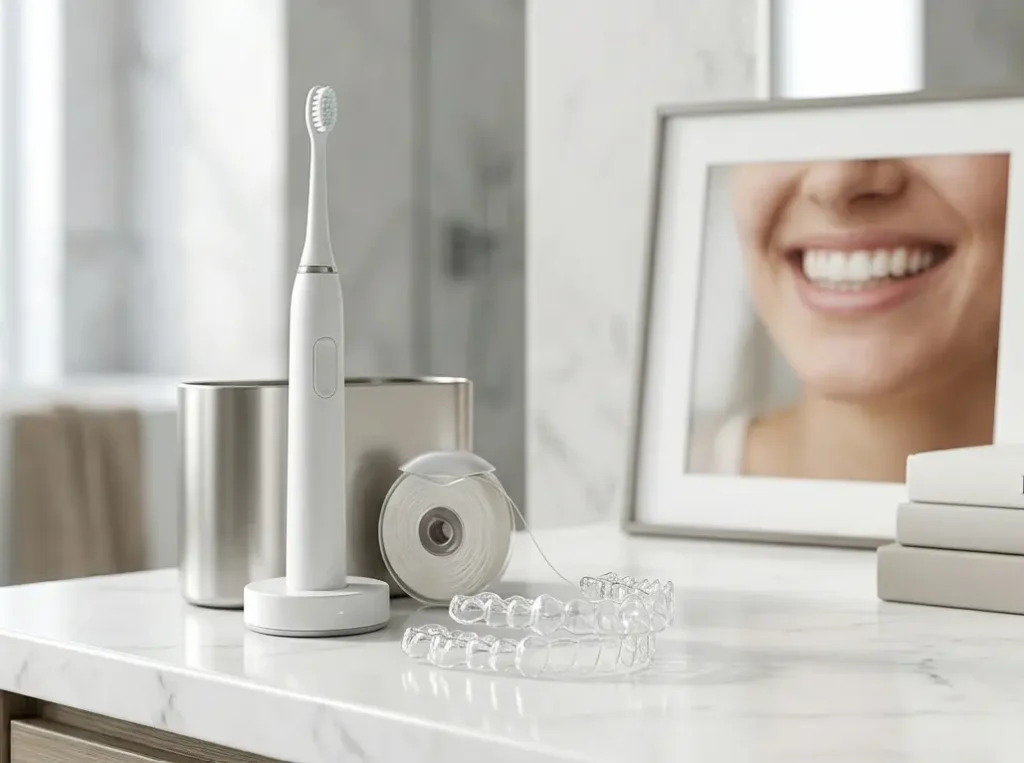
Most people don’t come in asking for a perfect smile. They come in because something feels slightly off in daily life — they smile carefully in photos, notice crowding every time they floss, or catch themselves thinking about one tooth more often than they want to.
That’s a more honest starting point than “I want straighter teeth.” And it leads to a more honest conversation about what orthodontic treatment actually changes — because the real benefits of straight teeth extend well beyond what shows up in a photo.
Straighter teeth are often easier to keep clean. They distribute bite forces more evenly. They stop requiring the kind of low-level daily management that most people don’t even realize they’ve been doing. And yes — for many patients, the confidence shift that follows is bigger than they expected.
In this guide
- The health and hygiene benefits of straight teeth
- How alignment affects bite function and long-term wear
- The confidence changes patients don’t always anticipate
- Why adult orthodontics looks different than people expect
- How Invisalign fits into modern adult life
- Starting with the right goal
- Frequently asked questions
The Health and Hygiene Benefits of Straight Teeth
The first change most patients notice after orthodontic treatment isn’t dramatic. It’s practical. Teeth that align more cleanly are easier to brush and floss thoroughly — there are fewer tight, overlapping areas where plaque accumulates and sits undisturbed between cleanings.
That matters more than it sounds. The frustration of crooked teeth isn’t usually one big problem — it’s the same small annoyance repeating daily. Food catches in one spot. Floss shreds. One area always feels harder to clean than it should. Over months and years, those spots become higher-risk zones for cavities and gum disease.
The American Association of Orthodontists notes that orthodontic treatment can improve oral hygiene and help prevent future dental problems. Better access for cleaning isn’t a side benefit — for many patients, it’s one of the most durable improvements treatment provides.
Easier to clean
Fewer overlapping surfaces means toothbrush bristles and floss can reach more of each tooth. Plaque has fewer places to hide between visits.
Lower decay risk
Hard-to-clean areas are consistently higher-risk for cavities. Better alignment reduces the number of those zones throughout the mouth.
Healthier gums
Plaque buildup at the gum line drives gum disease. Teeth that are easier to clean support healthier gum tissue over time.
Less daily friction
Cleaning becomes a routine rather than a struggle. For many patients, that alone changes how consistently they maintain it.
How Alignment Affects Bite Function and Long-Term Wear
Beyond hygiene, straight teeth affect how the mouth actually works — and how it holds up over time.
When teeth are misaligned, the bite often distributes force unevenly. Certain teeth absorb more pressure than they were designed to handle. Others barely make contact. Over years, that imbalance contributes to premature wear on specific teeth, sensitivity, and sometimes jaw discomfort. Patients don’t always describe this in clinical language — they say things like “one side does all the work” or “a few teeth hit first.”
The Cleveland Clinic notes that untreated malocclusion can contribute to tooth erosion, gum problems, and jaw discomfort over time. The AAO also identifies improved biting and chewing function among the core outcomes of orthodontic treatment.
None of this is dramatic at first. It becomes more significant over a decade than it does over a month. That’s exactly why addressing alignment earlier tends to produce better long-term outcomes — not because the aesthetic gap is larger, but because the functional wear accumulates quietly and compounds.
The practical implication: A smile that looks slightly crowded isn’t only a cosmetic concern. It may also be distributing bite forces unevenly, making thorough cleaning harder, and setting up certain teeth for accelerated wear. Orthodontics, in the right case, addresses all three simultaneously.
The Confidence Changes Patients Don’t Always Anticipate
A lot of people spend years adapting to a smile they don’t fully trust. They learn their angles. They cover their mouth when they laugh. They smile with their lips closed in photos — not by conscious decision, but because it became the default a long time ago.
After treatment, the change is often quieter than people expect. It’s not “my teeth are straight now.” It’s “I stopped thinking about my smile every time someone took a picture.” That kind of background relief tends to be more significant than patients anticipate.
What the research shows: A 2025 review found that orthodontic treatment can improve psychological and social well-being in patients with misaligned teeth. A 2023 study found measurable improvement in oral-health-related quality of life following orthodontic treatment. These aren’t marginal findings — they reflect changes patients consistently report in how they experience social situations, photos, and professional interactions.
Patients describe the shift in ordinary terms:
- Smiling more freely — without calculating the angle first
- Stopping the habit of monitoring one tooth during conversations
- Feeling less tense in photos and on video calls
- Spending less social energy on self-consciousness and more on being present
That is where orthodontics starts to feel like a wellness decision, not just an aesthetic one. And for many patients, it’s the part of treatment they valued most — even if it wasn’t what brought them in initially.
Why Adult Orthodontics Looks Different Than People Expect
Adults approach orthodontics differently than teenagers do. Most aren’t looking for a reinvention. They want a result that feels believable, fits into their life, and is worth the time and investment. They’re usually more aware of function than aesthetics — they notice the crowding when they clean, the shifting since their last set of retainers, the bite that feels slightly less settled than it used to.
They also notice new things with age. Teeth shift naturally over time — especially in adults who wore braces as teenagers but didn’t maintain retainers consistently. A bite that felt fine at 25 may feel different at 40. The crowding that was mild becomes more noticeable as gum tissue changes. These are the realities that bring adults into the orthodontic conversation on their own terms, usually with more specific goals and less patience for treatment that disrupts daily life.
There is no upper age limit for orthodontic treatment. Adults in their 30s, 40s, 50s, and beyond are regularly excellent candidates — for clear aligners and, in some cases, traditional options. What matters is the health of the teeth and supporting structures, not chronological age.
How Invisalign Fits Into Modern Adult Life
For many adults, the concern isn’t whether they want straighter teeth. It’s whether treatment will take over how they work, socialize, and move through the day. That’s where clear aligner therapy changes the calculus.
Invisalign aligners are removable and nearly invisible during wear. There are no brackets to irritate soft tissue, no dietary restrictions, and no impact on how you look in professional or social settings. You remove them to eat, brush, and floss — then put them back in. For most adults with mild to moderate crowding, spacing, or certain bite issues, clear aligners are a clinically appropriate option that genuinely fits into a normal life.
At O2 Dental Group, Invisalign treatment begins with a digital scan — no physical impressions — and a customized treatment plan built around your specific anatomy and goals. You can often see a digital preview of your projected outcome before committing to anything.
That doesn’t mean every case is suited for clear aligners. More complex bite correction sometimes requires other approaches. The right answer depends on the specifics of your teeth, your bite, and what you’re trying to achieve — which is what a consultation is for.
Wondering whether Invisalign or orthodontic treatment is right for you?
O2 Dental Group offers free consultations at all North Carolina locations.
Starting With the Right Goal
The best orthodontic decisions rarely start with “I want perfect teeth.” They start somewhere more personal — and more specific.
I want to stop thinking about this every day. I want my bite to feel balanced. I want cleaning to stop being a struggle. I want to smile in photos without planning it. I want my teeth to match the way I actually feel.
Those goals are honest. They’re also achievable. And they tend to produce better outcomes than chasing an abstract ideal — because the treatment plan gets built around real problems and real expectations, rather than a version of a smile the patient was never trying to have.
At O2 Dental Group, that’s the conversation we want to have. Not what the ideal outcome looks like in theory — but what’s bothering you now, what you want daily life to feel like, and whether treatment can realistically get you there. Most of the time, the answer is yes. What changes is the path, the timeline, and the approach.
A straighter smile changes more than the mirror. It changes how often you think about your mouth — and for most patients who’ve been managing that low-level mental load for years, the relief turns out to be the most lasting part of the result.
Frequently Asked Questions
Are the benefits of straight teeth only cosmetic?
No. While straighter teeth often look better, the functional benefits are significant. Better-aligned teeth are easier to clean thoroughly, reducing the risk of decay and gum disease. They also distribute bite forces more evenly, reducing strain on individual teeth. The Cleveland Clinic notes that untreated malocclusion can contribute to tooth wear, gum problems, and jaw discomfort over time.
Can straightening your teeth really improve confidence?
Yes, and the research supports it. A 2025 review found orthodontic treatment can improve psychological and social well-being in patients with misaligned teeth. A 2023 study found measurable improvement in oral-health-related quality of life after orthodontic treatment. Patients often describe the change as quieter than expected — less self-monitoring in conversations, less anxiety in photos, more spontaneous smiling.
Do straight teeth make brushing and flossing easier?
Often significantly so. Crowded or overlapping teeth create tight spaces where toothbrush bristles and floss can’t reach effectively. Plaque accumulates there, raising the risk of cavities and gum disease. The AAO notes that orthodontic treatment can improve oral hygiene and help prevent future dental problems. Many patients are surprised by how much easier their cleaning routine becomes after treatment.
Can Invisalign fix more than just appearance?
Yes. Clear aligners can address crowding, spacing, and a range of bite issues — not just cosmetic appearance. Correcting these issues can improve bite function, reduce uneven tooth wear, and make oral hygiene easier. Whether Invisalign is appropriate depends on the type and severity of misalignment — a consultation is the best way to determine fit.
Are adults good candidates for orthodontic treatment?
Yes. There is no upper age limit for orthodontic treatment. Adults are frequently excellent candidates for both clear aligners and traditional orthodontics. Many pursue treatment after noticing shifting in their 30s, 40s, or later — often because previous treatment was done without retainers, or because natural age-related changes have affected their bite. Modern options are designed to fit professional and family life.
Can crooked teeth cause health problems beyond appearance?
Yes. Misaligned teeth can contribute to plaque retention in hard-to-clean areas, increasing the risk of decay and gum disease. They can also create uneven bite pressure that leads to premature wear, enamel erosion, and jaw discomfort. Cleveland Clinic notes that untreated malocclusion can contribute to tooth erosion, gum disease, and temporomandibular joint (TMJ) problems.
Is Invisalign the only adult orthodontic option?
No. Adult orthodontic options include clear aligner therapy, ceramic braces, and traditional metal braces. The right option depends on the complexity of the case, lifestyle, and patient preference. Clear aligners are popular because they are removable and nearly invisible, but they aren’t suitable for every case. A consultation is the best way to understand which options apply to your situation.
Why do so many adults delay orthodontic treatment?
The most common reasons are visibility concerns, cost, time commitment, and underestimating the functional benefits. Many adults assume orthodontics is a teenage thing, or that their case isn’t significant enough. In practice, many find that clear aligner options are far less disruptive than expected — and that the functional and confidence improvements matter as much as the cosmetic result.
How long does adult orthodontic treatment typically take?
It depends on the case. Mild to moderate crowding or spacing treated with Invisalign may take 6 to 18 months. More complex bite correction can take longer. A consultation with digital scanning gives a realistic timeline for your specific situation — there’s no universal answer.
Related Pages
- Invisalign & Orthodontics at O2 Dental Group
- Financing & Insurance Options
- O2 Advantage Membership Plan
- Request an Appointment
- More from the O2 Dental Group Blog

Add O2 Dental Group to your Preferred Sources
