
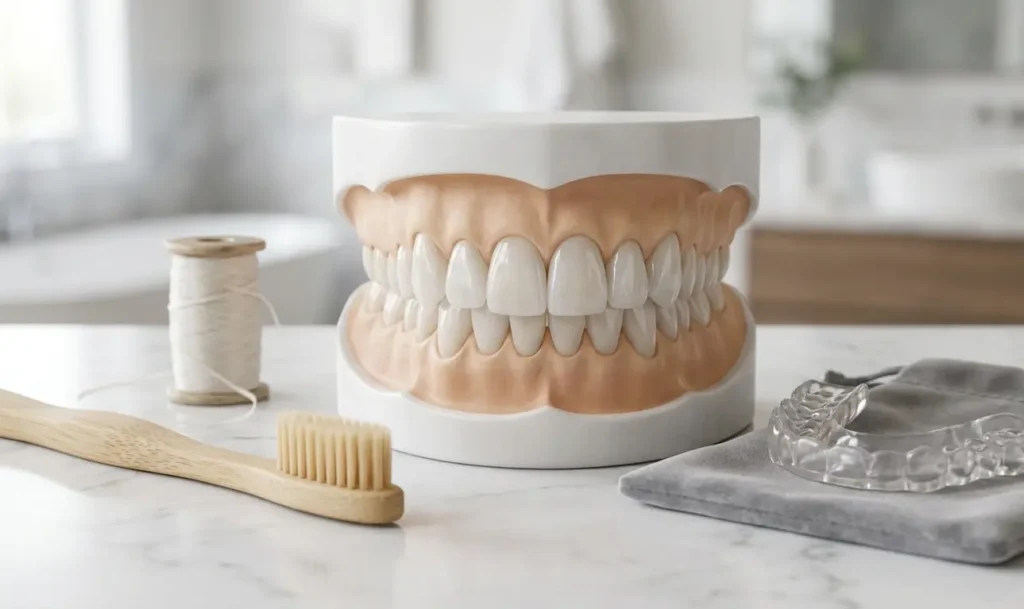
The placement appointment gets a lot of attention. The reveal, the first look, the before-and-after photos. What happens after that appointment — in the months and years of regular life — is what actually determines whether the investment holds up.
Porcelain veneers are durable, but they are not indestructible. Cleveland Clinic puts the average lifespan at 10 to 15 years with proper care. That range is wide for a reason: two patients can get the same veneers from the same dentist and end up with results that diverge significantly based on bite habits, hygiene consistency, and whether small issues were addressed early or ignored until they became larger ones. This article covers the practical side of that equation — what protects veneers, what damages them, and what questions to bring to your dentist before either becomes a problem.
The Tooth Underneath Still Needs Attention
Porcelain does not decay. That much is true. The natural tooth structure underneath the veneer absolutely can, and this is the part of veneer maintenance that patients most commonly overlook. Plaque does not read a surface as porcelain and give it a pass — it accumulates along gum margins, around bonding edges, and on the natural tooth enamel adjacent to and beneath the veneer just as it would on any unrestored tooth.
The American Dental Association is direct on this point: cavities can still form under or around a veneer, which means brushing with fluoride toothpaste twice a day and cleaning between teeth daily is not optional after veneer placement. If anything, it matters more. A cavity developing beneath a veneer is a more complicated clinical situation than a cavity on an untreated tooth, and preventing it is significantly easier than treating it.
The technique matters too. Firm scrubbing does not clean better than gentle brushing — it irritates gum tissue, can expose bonding margins over time, and gradually works against the healthy gumline that frames the veneer. A soft-bristled brush, proper angle at the gumline, and consistent flossing cover most of what is needed.
What Actually Shortens Veneer Lifespan
Patients often assume veneers fail because of cleaning habits, but bite forces are just as likely a culprit and considerably less visible. Grinding and clenching — bruxism — place lateral and compressive forces on veneers that accumulate over years of use. The edges are particularly vulnerable. A veneer that chips along the incisal edge almost always has a bite-related component, whether that is nocturnal grinding, a heavy opposing tooth, or a bite relationship that was not fully addressed before veneer placement.
Patients frequently do not know they grind. It happens during sleep, produces no immediate pain, and only becomes visible to a dentist through wear patterns identified during a routine examination. By the time a patient notices a chip or a rough edge, the underlying habit has usually been active for some time.
A night guard does not mean anything is wrong with the veneers or the bite. It means the bite is being protected during the hours when the patient cannot consciously control it. For anyone with a history of clenching, bruxism, or even jaw tension upon waking, a night guard is a straightforward protective measure that extends veneer lifespan meaningfully.
Beyond grinding, the other common accelerants of veneer damage: biting fingernails, chewing pens or ice, opening packaging with teeth, and regularly consuming extremely hard foods. None of these are clinical catastrophes on their own, but repeated over years they create the kind of cumulative force that shows up eventually in chips and bonding stress.
Staining — What Porcelain Resists and What It Does Not
Porcelain is significantly more stain-resistant than natural enamel. Coffee, red wine, and tea that would gradually discolor an untreated tooth will not penetrate well-glazed porcelain the same way. That does not mean the overall smile is immune to staining, though, and this distinction matters for patients who want a consistent result over time.
The edges where porcelain meets tooth — the bonding margins — can pick up discoloration from dark beverages and tobacco. The natural teeth visible beside and behind the veneers can shift shade while the porcelain stays fixed, creating a gradual mismatch that makes the smile look uneven. And if polishing or professional cleaning is not keeping the surface free of surface deposits, buildup near the gumline can make an otherwise bright smile look dingy even when the porcelain itself is intact.
Regular professional cleanings address most of this. The hygienist can clean areas that are difficult to reach at home, assess the margins, and polish the porcelain safely. For patients considering whitening of the natural teeth to maintain shade harmony with existing veneers, the conversation starts with the dentist — porcelain does not respond to bleaching agents, and whitening non-veneered teeth without a plan can create visible shade differences that require attention.
When to Call Before It Gets Worse
The patients who get the most out of their veneers over time are not necessarily the ones with the most elaborate maintenance routines. They are the ones who call when something changes rather than waiting to see if it resolves on its own.
A rough edge that appeared overnight is worth a phone call. A small chip on an incisal edge is worth having evaluated even if it does not hurt. A slight change in how the bite feels — a veneer hitting differently, a sensation of pressure that was not there before — is information the dentist can use before a more involved problem develops. A change near the gumline that looks like slight darkening or recession around the veneer margin is worth showing to the dentist at the next appointment or sooner.
None of these are necessarily serious on their own. Some are simple to address early and considerably more complex to address later. The clinical calculus on veneers is similar to most dental work: catching something at its earliest stage almost always means a smaller intervention, a faster fix, and a lower cost than addressing the same issue after it has progressed.
What Professional Visits Are Actually Doing for Veneers
The ADA’s patient guidance on veneers notes that no special maintenance is required beyond good daily oral hygiene and regular dental care. That is reassuring and also accurate — veneers are not high-maintenance restorations. But “regular dental care” is doing meaningful work in that sentence.
At a professional visit with veneers, the hygienist and dentist are doing things home care cannot replicate: cleaning subgingival deposits near veneer margins, evaluating the bond integrity, checking the bite relationship between the veneered teeth and their opposing contacts, assessing gum health around the restorations, and looking at the porcelain surface for early signs of wear or stress. These evaluations happen in minutes during a routine appointment, but the information they produce can flag issues before they become visible to the patient or start affecting function.
For patients who have invested in a full smile design involving multiple veneers, these visits are part of what protects the coherence of the whole result over years. A smile that looked naturally balanced at placement can drift if individual changes go unmonitored — a bite shift here, a margin change there — in ways that do not announce themselves dramatically but do accumulate.
The Maintenance Mindset
Veneers do not require a complicated life. They require a consistent one. The day-to-day is simple: brush gently, floss, wear the night guard if the dentist recommended one, avoid using teeth as tools, keep appointments, and call when something changes. That is genuinely most of it.
The patients who tend to struggle with veneer longevity are not the ones who skip a flossing session here or there. They are the ones who delay addressing a chip because it is not painful, who stop wearing a night guard because it is uncomfortable without finding an alternative, or who avoid scheduling the six-month appointment because they do not have any specific concerns. Small gaps in consistency compound over years in ways that are not apparent until they are.
At O2 Dental Group, veneer care is part of an ongoing clinical relationship rather than a series of one-time procedures. Placement is the beginning of the conversation, not the end of it. If your veneers are new, if they are aging and you are curious about where they stand, or if you are still in the planning stage, learn more about our veneer services or request a consultation and we will give you a straight assessment of what you are working with and what the path forward looks like.
Frequently Asked Questions
How long do porcelain veneers last?
Cleveland Clinic notes that dental veneers last about 10 to 15 years on average with proper care. Lifespan depends on bite forces, hygiene, the material used, clinical placement, and daily habits. Patients who grind or clench, neglect flossing, or regularly bite hard objects tend to see shorter lifespans. Patients with stable bites and consistent home care often see veneers last toward or beyond the upper end of that range.
Do porcelain veneers need special toothpaste?
Most patients do best with standard fluoride toothpaste and a soft-bristled toothbrush. Avoid highly abrasive whitening toothpastes, which can dull the porcelain surface over time. If you are uncertain about a specific product, ask your dentist before using it regularly on veneered teeth.
Can porcelain veneers stain?
Porcelain itself resists staining better than natural enamel, but the edges where the veneer meets the tooth and the natural teeth surrounding the veneers can discolor over time. Coffee, tea, red wine, and tobacco are the main culprits. Regular professional cleanings help keep the overall smile looking consistent.
Should I wear a night guard if I have porcelain veneers?
If you grind or clench your teeth — especially during sleep — a night guard is strongly worth considering. Grinding places repeated lateral forces on veneers that can cause chipping, edge wear, or bonding stress over time. Many patients are unaware they grind until a dentist identifies wear patterns during a routine exam.
Can I whiten my teeth after getting veneers?
Porcelain veneers do not respond to whitening agents — the porcelain shade is fixed. Natural teeth around the veneers can be whitened, but doing so without planning can create visible shade differences between the veneered and non-veneered teeth. Always consult your dentist before whitening any teeth in a smile that includes veneers.
What should I do if a veneer chips or feels rough?
Call your dentist rather than waiting to see if it gets worse. A small chip or rough edge may be simple to address early but can progress to a more involved repair if ignored. Your dentist can evaluate whether the veneer surface, bond, or margin needs attention and whether a bite issue is contributing to the problem.
Questions About Your Veneers?
O2 Dental Group offers porcelain veneer placement and ongoing cosmetic care across our North Carolina locations. Whether you have existing veneers that need evaluation or are planning a new smile design, request a consultation online and let us give you a straight answer about where things stand.

