
Most people who end up at a dental office asking about sleep apnea did not start by thinking they had sleep apnea. They started by getting elbowed awake too many times, or by waking up with a headache three mornings in a row, or by finally agreeing with a partner who has been saying for months that something is wrong. The path to treatment usually begins with something smaller — a complaint, a pattern, a suspicion — and takes a while to get taken seriously.
This is a guide to what a dental team can actually do for sleep apnea and snoring, what the clinical options look like, and when a dentist is the right starting point versus when you need to be somewhere else first. If you are a Wilmington patient wondering whether an oral appliance could help — or whether you even need one — this covers the ground.
What Sleep Apnea Actually Is — and Why It Matters
Obstructive sleep apnea happens when the muscles in the throat relax during sleep to the point where soft tissue collapses and blocks the airway. The blockage reduces or stops airflow, oxygen levels drop, the brain registers the threat and partially wakes the body to restore breathing — and the cycle repeats, sometimes dozens or hundreds of times per night. The person rarely remembers the waking. What they do remember is being exhausted despite spending enough hours in bed.
The National Heart, Lung, and Blood Institute describes sleep apnea as a condition where breathing repeatedly stops and starts during sleep, preventing the body from getting enough oxygen. That oxygen disruption is what connects sleep apnea to a longer list of health concerns than most patients realize: elevated blood pressure, cardiovascular strain, metabolic changes, cognitive effects, and impaired daytime function. It is not just a snoring problem or an inconvenience. Left untreated in moderate to severe cases, it carries real medical risk over time.
Snoring is not the same as sleep apnea. Many people snore without having apnea. But snoring — particularly loud, frequent snoring with witnessed pauses in breathing, gasping, or choking — is one of the most common presenting symptoms. If the snoring is also paired with morning headaches, dry mouth, waking unrefreshed, or significant daytime fatigue, those combinations are worth evaluating rather than normalizing.
What a Dentist Can and Cannot Do
This distinction matters and gets glossed over in a lot of dental marketing around sleep apnea. A dentist cannot diagnose sleep apnea. Diagnosis requires a sleep study — either a polysomnogram conducted in a sleep lab or a home sleep apnea test ordered by a physician — and the results need to be interpreted by a qualified medical provider. No amount of clinical examination, symptom assessment, or questionnaire scoring at a dental office constitutes a diagnosis.
What a dentist trained in dental sleep medicine can do is substantial within that boundary. They can screen for symptoms and risk factors, identify patients who should be referred for a sleep study, work collaboratively with a patient’s physician once a diagnosis exists, fabricate and fit a custom oral appliance, and manage the ongoing follow-up care that keeps the device working correctly. For patients who already have a diagnosis and are not tolerating CPAP, or for patients who want to start the conversation before committing to a medical referral, a dental office is a reasonable starting point.
The American Academy of Dental Sleep Medicine confirms that dentists trained in oral appliance therapy can work with patients and physicians to identify the right treatment approach. That collaborative model — the dentist managing the appliance, the physician managing the diagnosis and medical oversight — is how dental sleep medicine is supposed to work.
Oral Appliance Therapy — The Clinical Picture
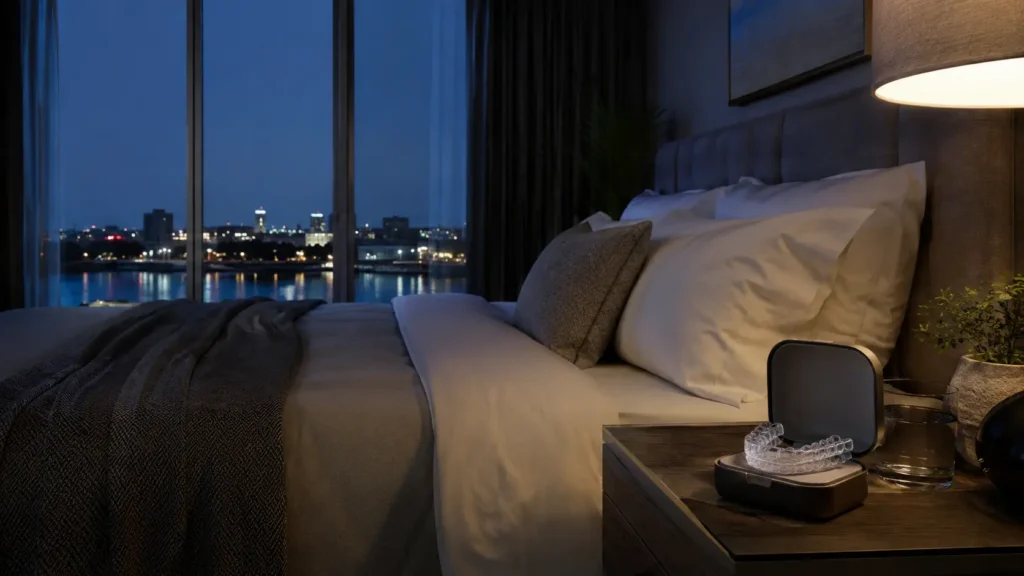
A custom oral appliance for sleep apnea is a removable device worn during sleep that repositions the lower jaw slightly forward. That forward positioning tightens the soft tissue and muscles of the upper airway, which reduces the tendency for the airway to collapse during sleep. The result, for most patients who respond well, is a meaningful reduction in apnea events and a significant reduction or elimination of snoring.
The American Academy of Dental Sleep Medicine supports oral appliance therapy as a first-line treatment option for mild to moderate obstructive sleep apnea, and as an alternative for severe OSA in patients who cannot tolerate CPAP. The American Dental Association has noted that oral appliances have been viewed as a simpler therapeutic option, particularly for patients who struggle with PAP therapy compliance.
The compliance point is clinically significant. CPAP, when used correctly every night, is generally more effective at reducing apnea events than an oral appliance. The problem is that a large percentage of CPAP users do not use it consistently — because of mask discomfort, noise, travel inconvenience, claustrophobia, or simply the friction of maintaining the equipment. A treatment that works less well in theory but gets used every night often produces better real-world outcomes than a treatment that works better in theory but gets abandoned within months.
For Wilmington patients who travel frequently between the coast and other locations, manage compact living spaces, or have tried CPAP and found it unsustainable, an oral appliance may be worth a genuine conversation.
What the Fitting Process Looks Like
A custom oral appliance is not a generic mouthguard picked up at a pharmacy. The fabrication process starts with digital scans or impressions of the teeth, which are sent to a dental lab that manufactures the device to the patient’s exact specifications. The appliance is then delivered and fitted at the office, with adjustments made to the jaw position to find the right balance between comfort and airway opening.
Most patients need a few weeks to adapt. Initial symptoms during the adjustment period can include mild jaw soreness, increased salivation, or minor tooth sensitivity — these are common and typically resolve as the jaw adapts to the new resting position during sleep. Follow-up appointments are built into the process to refine the fit, assess the patient’s response, and make incremental adjustments to the jaw advancement if needed.
A device that feels uncomfortable after the adjustment period should be evaluated, not abandoned. The fit can almost always be improved. A device that is never worn because it is uncomfortable is clinically useless, and the dentist needs to know when that is happening.
Ongoing Care Matters More Than the Initial Fit
Sleep apnea is a chronic condition. An oral appliance is not a one-time intervention. Symptoms can return or change over time as body weight changes, dental work alters bite relationships, the appliance material wears, or the jaw position needs recalibration. The device itself has a lifespan and will eventually need to be replaced.
Ongoing follow-up care — at intervals your dental team will recommend based on your specific situation — keeps the device aligned with your current needs rather than your needs at the time it was first made. It also gives the team a chance to check whether the treatment is still working. If a bed partner is still reporting significant snoring, or if daytime fatigue has returned, that information should prompt a reassessment rather than just continued use of a device that may no longer be positioned correctly.
For patients with diagnosed severe OSA, periodic repeat sleep testing is often recommended to confirm that the appliance is maintaining adequate apnea control. This is coordinated with the referring physician, not managed by the dental office alone.
When to Bring It Up at a Dental Appointment
Patients often wait longer than they should because snoring feels embarrassing to mention, or because they assume a dentist is the wrong person to ask. Neither is true. A dental appointment is a reasonable place to raise sleep concerns, particularly if you are already established with a practice and the team knows your oral health history.
Bring it up when any of the following are part of your regular experience: snoring that is loud enough to disturb a partner, waking with a dry mouth or morning headache more than occasionally, feeling unrested despite spending seven or eight hours in bed, being told by a partner that you stop breathing or gasp during sleep, or having tried CPAP and found it unmanageable. You do not need to arrive with a diagnosis or precise clinical language. Describing the pattern in plain terms gives the team enough to work with.
O2 Dental Group of Wilmington offers sleep apnea and snoring treatment through custom oral appliance therapy at its Market Street location. For patients who are not sure where to start, the initial conversation can help clarify whether a dental solution is appropriate, whether a medical referral for a sleep study makes sense first, or both.
Frequently Asked Questions
Can a dentist treat sleep apnea in Wilmington?
Yes, with an important distinction. A dentist cannot diagnose sleep apnea — that requires a sleep study interpreted by a physician. But a dentist trained in dental sleep medicine can fabricate and fit a custom oral appliance for patients who have already been diagnosed, and can help patients who suspect sleep apnea start the evaluation process. O2 Dental Group of Wilmington offers oral appliance therapy and sleep apnea consultations at its Market Street location.
What is oral appliance therapy for sleep apnea?
Oral appliance therapy uses a custom-fitted removable device worn during sleep to reposition the lower jaw slightly forward, which keeps the upper airway open and reduces or eliminates apnea events and snoring. The American Academy of Dental Sleep Medicine supports oral appliance therapy as a first-line treatment for mild to moderate obstructive sleep apnea and for severe OSA in patients who cannot tolerate CPAP.
Is oral appliance therapy as effective as CPAP?
CPAP is generally considered more effective at reducing apnea events in severe OSA when used correctly and consistently. The clinical problem is compliance — many patients do not use CPAP consistently because of mask discomfort, noise, travel difficulty, or claustrophobia. Oral appliance therapy is typically less effective at apnea reduction than CPAP but more likely to actually be used, which often produces better real-world outcomes. For mild to moderate sleep apnea, oral appliances are a well-supported first-line option.
Does snoring always mean sleep apnea?
No. Snoring alone is not diagnostic of sleep apnea. Many people snore without having apnea. However, loud and frequent snoring — especially when combined with witnessed pauses in breathing, gasping during sleep, morning headaches, dry mouth, or significant daytime fatigue — is worth evaluating. A sleep study is the only way to confirm or rule out a diagnosis.
How long does it take to get used to an oral appliance?
Most patients adjust within two to four weeks. Initial side effects can include mild jaw soreness, increased saliva, or temporary tooth sensitivity — these typically resolve as the jaw adapts. Follow-up appointments allow the device to be adjusted for comfort and effectiveness. A device that remains uncomfortable after the adjustment period should be evaluated rather than abandoned.
Does O2 Dental Group in Wilmington offer sleep apnea treatment?
Yes. O2 Dental Group of Wilmington offers sleep apnea and snoring treatment through custom oral appliance therapy at its Market Street location at 7150 Market St, Suite 130, Wilmington NC 28411. Call (910) 377-6453 or book online to schedule a consultation.
Questions About Sleep Apnea or Snoring in Wilmington?
If snoring, fatigue, or suspected sleep apnea has been on your mind, a conversation with the O2 Dental Group of Wilmington team is a reasonable place to start. We can help clarify whether an oral appliance is the right path, whether a medical sleep study should come first, or how to coordinate care between your physician and our office.
O2 Dental Group of Wilmington
7150 Market St, Suite 130
Wilmington, NC 28411
(910) 377-6453
ilm@o2smiles.com
Book Online
|
Wilmington Office Info
|
Sleep Apnea & Snoring Treatment

Add O2 Dental Group to your Preferred Sources
