
I’m Dr. Olu Oyegunwa, founder of O2 Dental Group. Across our six North Carolina locations — Wilmington, Durham, Raleigh, Fayetteville, Siler City, and Southern Pines — we treat all three categories of tooth replacement, and I’ve spent more than fifteen years placing implants personally. My professional bias is toward implants when they fit, because they fit more often than people expect. But I’m going to spend the next few minutes giving you the honest version of this comparison, because there’s a real category of patients for whom a bridge or a denture is genuinely the better answer, and they deserve to know that too.
Why I lead with implants — when they fit
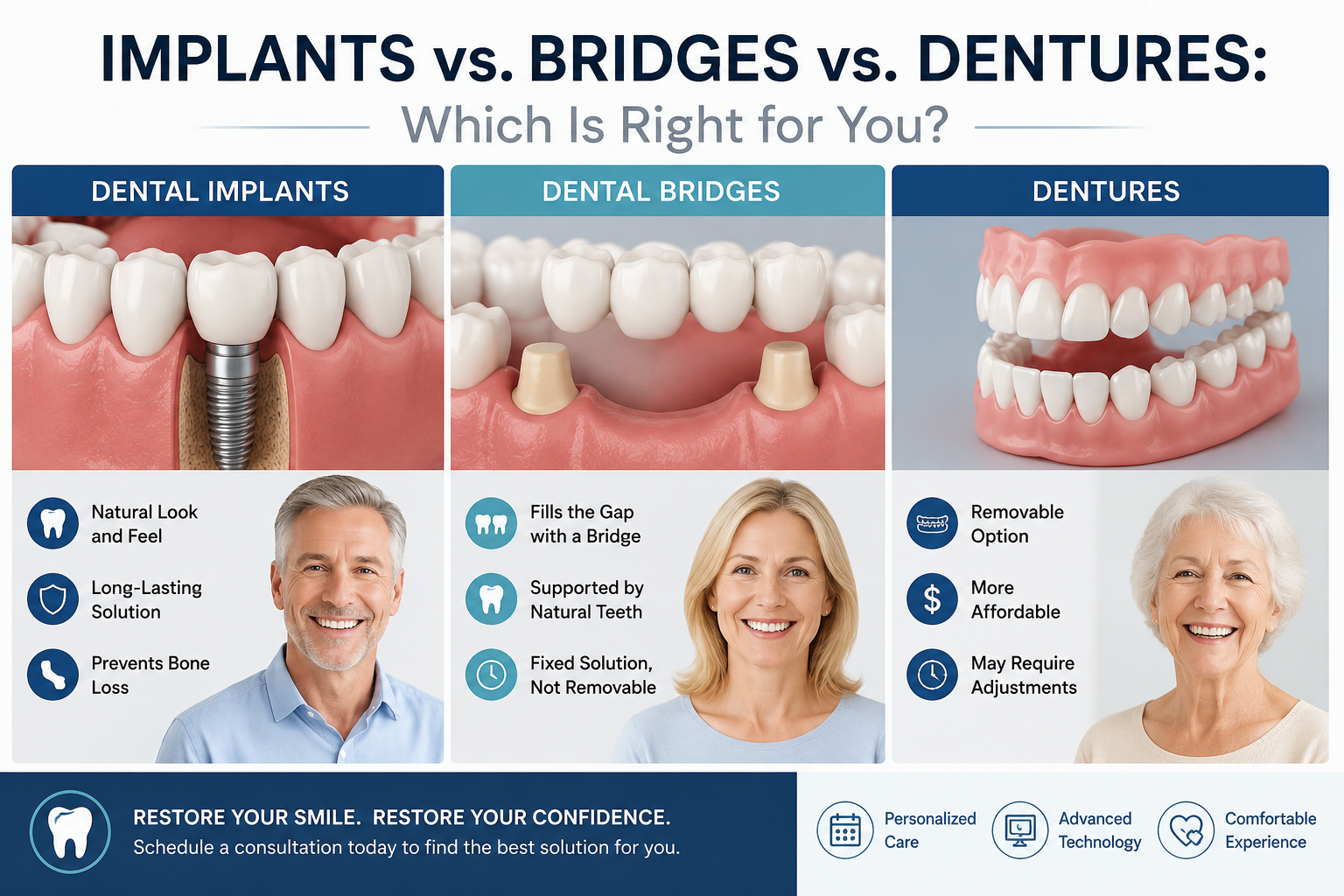
A dental implant is a small titanium post placed in your jawbone where the root of the missing tooth used to be. Over a few months, the bone integrates with the post (a process called osseointegration), creating a foundation as stable as a natural tooth root. Once integration is complete, a custom porcelain crown is placed on top, designed to look and function like the tooth that was lost.
The reason implants are usually the right answer when they fit comes down to four things:
They preserve the bone. When a tooth is lost and the space is left empty (or filled with a bridge that doesn’t go into the bone), the body resorbs the underlying bone over months and years because nothing is stimulating it to maintain itself. The “sunken-in” facial appearance of long-term denture wearers is the result of decades of this bone loss. An implant gives the bone a reason to stay, the way a natural tooth root does.
They don’t sacrifice neighboring teeth. A traditional fixed bridge requires the two healthy teeth on either side of the gap to be shaped down to support crowns. That’s real tooth structure modification that doesn’t grow back. An implant stands alone — the teeth around it stay completely intact.
They last. Modern implants are designed to last 20+ years and often longer with reasonable care. Bridges typically need replacement every 10–15 years. Dentures need replacement every 5–10 years and relining in between. Over a 30-year horizon, the implant case usually costs less in total than the bridge or denture case, because you’re not paying for repeated replacements.
They function like natural teeth. No slipping, no adhesive, no removable appliance to clean overnight. You eat what you want, brush and floss like natural teeth, and forget the tooth was ever missing.
At our six O2 Dental Group offices, I personally place implants at Wilmington, Durham, Raleigh, and Siler City. Our Fayetteville and Southern Pines offices have qualified in-house implant providers. Every location has on-site 3D CBCT imaging for surgical planning, which is the difference between predictable implant outcomes and guesswork. Single-tooth implants at our offices run $3,000–$5,500. Full-arch fixed implant reconstructions (All-on-4) run $25,000–$50,000 per arch.
For qualified candidates, we also do same-day implants — extraction, implant placement, and a temporary crown all in one visit, so you leave with a tooth in the socket rather than a gap to live with during healing. Not every patient is a same-day candidate. We determine that at the consultation through 3D imaging and tell you honestly which timeline applies to your case.
When a bridge is genuinely the right answer
Implants aren’t right for every case, and pretending otherwise is how patients end up with treatment plans that don’t fit their actual situation. The patterns where a bridge is the better call:
The teeth next to the gap already need crowns. If the adjacent teeth have large failing fillings, fractures, or significant decay that would require crowns within the next year or two anyway, incorporating them into a bridge effectively solves three problems with one procedure. The two crowns the adjacent teeth needed plus the false tooth filling the gap in between — all done as one connected restoration. The economics of this case usually favor the bridge over an implant plus two separate adjacent-tooth crowns.
The patient has medical conditions that complicate implant surgery. Patients on certain bisphosphonate medications for osteoporosis have an elevated risk of complications with implant placement. Patients with certain bleeding disorders, poorly controlled diabetes, or active heavy smoking habits have reduced implant success rates. For these patients, a traditional bridge avoids the surgical question entirely.
There’s not enough bone for an implant without major grafting. Long-standing tooth loss often comes with significant bone resorption in the area. Sometimes that bone can be rebuilt with grafting before implant placement, but the timeline and cost get significant. For patients who don’t want to commit to a multi-stage 12–18 month process, a bridge is faster.
The timeline is short. A traditional fixed bridge can be completed in 2–4 weeks across 2–3 visits. An implant takes 4–7 months total because of healing time. For a pre-wedding or pre-event situation where the patient genuinely needs a permanent restoration in place by a specific date, the bridge wins on calendar.
Traditional fixed bridges at our offices run $2,500–$6,000 depending on the number of teeth involved and the materials used. Implant-supported bridges — which use two implants to support a multi-tooth bridge without modifying any natural teeth — run $12,000–$18,000 for a typical four-unit case. The implant-supported version costs more upfront but lasts substantially longer.
When dentures are the right answer
The patient who comes to us missing most or all of their teeth in an arch is in a fundamentally different conversation than the patient missing one or two teeth. The trade-offs change. The economics change. The clinical reality changes.
For patients in this situation, the three main options are:
Traditional full dentures. A removable prosthetic that replaces the entire missing arch, resting on the gum ridge and staying in place through fit and suction. At our offices, traditional full dentures run $1,500–$3,500 per arch. They’re the most cost-accessible option for full-arch tooth replacement. Modern materials are dramatically better than the dentures of previous generations — thinner, more comfortable, more natural-looking. The upper arch in particular works well with traditional dentures because the larger surface area allows for good suction-based retention. The lower arch is harder because the tongue, smaller bone surface, and constant movement make stability more difficult — which is the single biggest reason patients hate their lower dentures.
Partial dentures. For patients missing some teeth but still retaining others, the partial fills in the missing spaces and clips or clasps onto the remaining natural teeth for support. The natural teeth provide stable anchorage that makes partials function much better than full dentures for most patients. Pricing runs $1,200–$3,000 depending on framework material and the number of teeth being replaced.
Implant-supported dentures (snap-in dentures). This is the option most patients aren’t told about clearly, and it’s the one that’s transformed denture wearing for the patients who choose it. Two to four implants are placed in the jawbone, and the denture snaps onto the implants instead of resting passively on the gum. The result is denture-level cost with implant-level retention — no slipping, no adhesive ever, and dramatically better chewing function. For the lower arch in particular, this is the option I recommend most often. Implant-supported dentures run $5,000–$15,000 per arch for the denture itself, plus the cost of the implants ($3,000–$5,500 each, with most lower-arch cases using two implants and most upper-arch cases using four).
One honest note about how we do dentures: impressions, fittings, and adjustments all happen in-house at our offices, but the actual denture fabrication goes to specialist dental labs we’ve worked with for years. We don’t have an on-site lab. This is standard for the industry and produces better results than offices that try to fabricate in-house with less specialized equipment — but I mention it so patients understand what they’re paying for and where the work happens.
The honest comparison at a glance
Here’s the practical comparison I walk patients through at the consultation:
| Dental Implant | Bridge | Denture | |
|---|---|---|---|
| Cost (single tooth replacement) | $3,000–$5,500 | $2,500–$6,000 (3-unit bridge) | $1,200–$3,000 (single-tooth partial) |
| Typical longevity | 20+ years | 10–15 years | 5–10 years (replacement); relines in between |
| Bone preservation | Yes — stimulates bone like a natural root | No bone stimulation underneath the false tooth | No — bone gradually resorbs over years |
| Affects neighboring teeth | No | Yes — adjacent teeth need crowns | Partials clip to neighbors; full dentures don’t |
| Treatment timeline | 4–7 months (or 1 day for qualified same-day cases) | 2–4 weeks | 4–6 weeks (traditional); 4–7 months (implant-supported) |
| Removable? | No | No | Yes (no for fixed All-on-4) |
The right answer for most single missing teeth is an implant, when bone and medical conditions allow. The right answer for most multiple-adjacent missing teeth is either an implant-supported bridge or individual implants. The right answer for most full-arch tooth loss is implant-supported dentures (for the lower arch especially) or All-on-4 fixed reconstruction for patients ready to commit to the higher upfront investment. Traditional bridges and traditional dentures remain the right answer for specific situations — budget constraints, medical contraindications, short timelines — but they shouldn’t be the default just because they’re the most familiar.
The long-term math people don’t think through
One conversation I have with almost every patient who balks at implant pricing: the upfront cost is not the same as the long-term cost.
A $4,500 implant that lasts 25 years works out to $180 per year of service. A $4,000 bridge that lasts 12 years works out to $333 per year of service, plus the cost of replacing it — and the second-generation bridge often needs more involved work because the supporting teeth have aged. A $2,500 denture that needs replacement every 7 years and a reline every 2–3 years adds up faster than people expect over a 25-year horizon.
I’m not saying this to push every patient toward an implant. Some patients genuinely can’t carry the upfront cost regardless of long-term math, and a bridge or denture is the right answer for their current circumstances. But the comparison should be honest. The “cheapest” option isn’t always cheapest when you measure it across the actual time horizon you’ll need it.
Insurance, financing, and the cost reality
Most dental insurance plans cover bridges and dentures as major restorative procedures at 50% after the deductible, up to the annual maximum (typically $1,000–$2,000 per year). Implant coverage is more variable — some plans cover the crown but not the implant, some cover neither, some cover both with their own rules and annual caps.
What we do at every consultation: verify your specific insurance benefits before any treatment, walk through what the plan actually covers, and give you a written itemized estimate of your patient-responsibility portion. For larger cases — particularly implants and full-arch reconstructions — Sunbit financing keeps payments manageable across the treatment timeline. For uninsured patients, the O2 Advantage Plan provides discounted rates with no waiting periods and no annual maximums.
The cost conversation should happen before treatment, in writing, with real numbers. That’s how every consultation at our offices works.
What to do today if you’re considering tooth replacement
If you’ve been thinking about replacing a missing tooth (or thinking about what to do with a tooth that’s about to come out), the consultation is the simple first step. Here’s the practical sequence:
Call the O2 location closest to you and book a tooth replacement consultation. Tell the scheduler whether you have a tooth that’s already been extracted (and roughly how long it’s been missing), a tooth currently scheduled for extraction, a failing tooth that may need to come out, or a full arch or near-full arch missing. That information helps us hold the right amount of time and prep the right imaging.
If you’ve had previous dental work in the area — old bridges, partials, crowns, root canals — bring those records to the consultation if available. Prior X-rays from another office are particularly helpful if you’ve been told elsewhere that implants weren’t an option.
If you’ve been quoted treatment by another office and you’re seeking a second opinion, that’s a common reason patients come to us. Bring the prior quote and any imaging. We’ll give you an honest read on whether their recommendation fits your case or whether there’s a better path we’d recommend instead.
Find your closest O2 office
Tooth replacement consultations are available at all six O2 Dental Group locations across North Carolina. On-site 3D CBCT imaging at every office, written treatment plans before any work begins, and the honest comparison of implants, bridges, and dentures applied to your specific case.
- Wilmington — 7150 Market St, Suite 130 — (910) 377-6453 — Book online
- Durham — 3219 Watkins Rd, Suite 103 — (919) 813-2267 — Book online
- Raleigh — 5321 Tin Roof Way, Suite 102 — (919) 341-4160 — Book online
- Fayetteville — 1916 Skibo Rd, Suite C3 — (910) 484-5141 — Book online
- Siler City — 103 Food Lion Plaza — (984) 265-1655 — Book online
- Southern Pines — 340 Capital Drive, Carthage — (910) 839-0055 — Book online
— Dr. Olu Oyegunwa, founder, O2 Dental Group
Frequently Asked Questions
1. Are dental implants better than bridges or dentures?
Implants are the most durable tooth replacement option in modern dentistry — they preserve the bone underneath, last 20+ years on average, and don’t require modifying neighboring teeth. For most patients with adequate bone and no medical contraindications, implants are the better long-term answer. Bridges remain the right choice when adjacent teeth already need crowns, when bone or medical conditions complicate implant surgery, or when timeline is short. Dentures are the right answer for patients missing most or all of an arch who need an immediately affordable solution. Neither bridges nor dentures are inferior categorically — they fit specific situations better than implants do.
2. How much do dental implants cost in North Carolina at O2 Dental Group?
Single-tooth implants at our six NC offices run $3,000–$5,500. Full-arch fixed implant reconstructions (All-on-4) run $25,000–$50,000 per arch. Implant-supported dentures fall in between at $5,000–$15,000 for the denture component, plus the cost of the implants themselves. Pricing depends on whether grafting is needed, the type of final restoration, and the case complexity. We give every patient a written, itemized estimate at the consultation.
3. Can I get same-day dental implants?
For qualified candidates with adequate bone and an appropriate clinical picture identified at the consultation, yes. We can combine extraction, implant placement, and a temporary crown into a single treatment day. The permanent final crown is placed a few months later after the implant integrates with the bone. Not every patient is a same-day candidate — we determine candidacy at the consultation through 3D CBCT imaging and tell you honestly which path applies.
4. What’s the difference between a traditional bridge and an implant-supported bridge?
A traditional bridge uses the two healthy teeth on either side of a missing tooth as anchor points — they get crowned, with a false tooth suspended between them. An implant-supported bridge uses two implants placed into the bone as the anchor points, supporting a bridge of three or four teeth without modifying any natural teeth. Implant-supported bridges last longer (20+ years vs 10–15 for traditional), preserve the bone underneath, and don’t require sacrificing healthy adjacent tooth structure. They cost more upfront. The right choice depends on whether the adjacent teeth are already failing and on your bone health.
5. Are implant-supported dentures better than regular dentures?
For most patients, yes — particularly for the lower arch, where traditional full dentures have well-known stability problems. Implant-supported dentures snap onto two to four implants placed in the jawbone, giving you dramatically better chewing function, no need for adhesive, no slipping during conversation, and the ability to eat foods that traditional denture wearers typically avoid (steak, apples, corn on the cob). The trade-off is higher upfront cost ($5,000–$15,000 for the denture plus implants) and a longer treatment timeline because the implants need to heal. For patients on a tighter budget or with medical conditions complicating implant surgery, traditional dentures remain a viable option.
6. How long do dental implants, bridges, and dentures last?
Dental implants are designed to last 20+ years and often longer with reasonable care. Traditional fixed bridges typically last 10–15 years before needing replacement. Implant-supported bridges last 20+ years because they don’t depend on the long-term health of natural anchor teeth. Full dentures typically need replacement every 5–10 years because the underlying gum and bone change shape over time. Partial dentures can last longer if the supporting natural teeth remain healthy. Implant-supported dentures last 20+ years for the implant portion; the denture component itself may need replacement every 7–10 years.
7. Does dental insurance cover implants, bridges, and dentures?
Coverage varies significantly. Bridges and dentures are typically covered as major restorative procedures at 50% after the deductible, up to the annual maximum (usually $1,000–$2,000 per year). Implant coverage is more variable — some plans cover the crown but not the implant, some cover neither, some cover both with their own rules. We verify your specific coverage before any treatment so the cost conversation is based on real numbers. Sunbit financing and the O2 Advantage Plan cover whatever insurance doesn’t.
8. Who shouldn’t get dental implants?
Implant candidacy depends on bone health, overall medical health, and certain specific conditions. Patients with significant uncontrolled bone loss may need extensive grafting before placement, or may be better served by a bridge or denture. Patients on certain bisphosphonate medications for osteoporosis have an elevated risk of complications and need careful evaluation. Patients with poorly controlled diabetes, active smokers (smoking significantly reduces implant success rates), and patients with certain bleeding disorders may not be ideal candidates. We evaluate these factors at the consultation with 3D CBCT imaging and a medical history review. If implants aren’t the right answer for your case, we tell you honestly and walk through bridge and denture alternatives.

Add O2 Dental Group to your Preferred Sources
