
I’m Dr. Olu Oyegunwa, founder of O2 Dental Group. We operate six offices across North Carolina — Wilmington, Durham, Raleigh, Fayetteville, Siler City, and Southern Pines — and tooth extractions are one of the procedures we handle most often. Across our six locations, our team performs hundreds of extractions a year, in-house, without routine referrals to oral surgeons for the standard cases.
That last part matters more than most patients realize, so I want to spend the next few minutes explaining why.
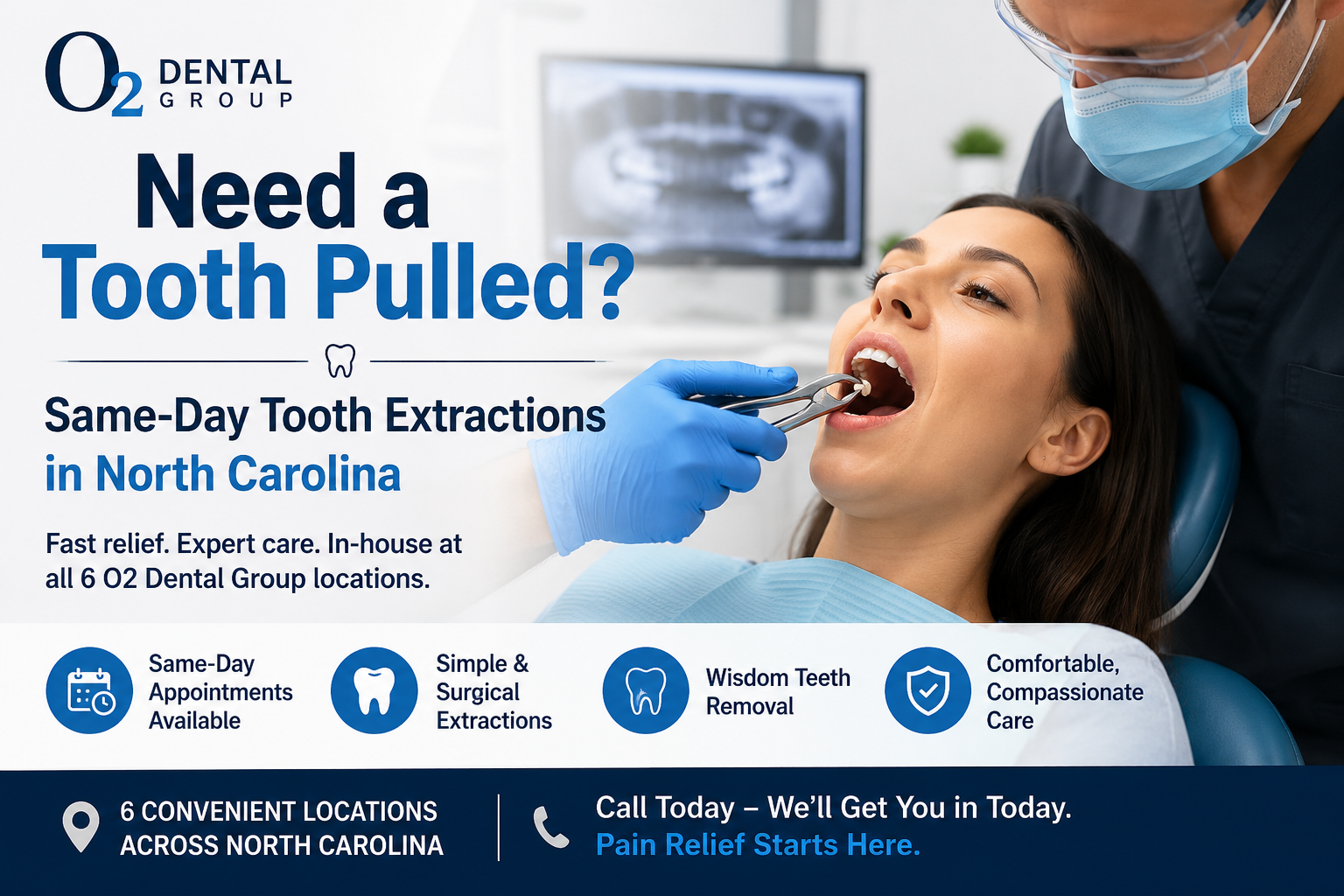
Two reasons most patients end up in our chair for an extraction
When someone calls our office about an extraction, they’re almost always in one of two situations.
The first is wisdom teeth. They’re crowding the back of the mouth, getting infected on and off, or impacted under the gum tissue and starting to cause real problems. The patient is usually in their late teens or early twenties, often referred by a general dentist who told them to “go see an oral surgeon.” The wisdom-teeth-via-oral-surgeon pathway is what most parents experienced when they were that age, and it’s still standard advice at many practices. It doesn’t have to be.
The second situation is a tooth that’s beyond saving. A molar that cracked vertically below the gumline. A tooth that had a root canal years ago and is now reinfected past the point of retreatment. A heavily decayed tooth that doesn’t have enough remaining structure to support a crown. A tooth with severe periodontal disease where the bone underneath has resorbed so much that nothing’s holding it in anymore. These cases come from patients across every age range, and they share one thing in common: by the time they reach our office, the patient has often been living with the problem longer than they should have because they were dreading what came next.
Both situations get resolved faster, more affordably, and more comfortably than people expect.
Wisdom teeth — when removal is necessary, and when it isn’t
Not every wisdom tooth needs to come out. That’s a thing I tell at least one patient a week.
A wisdom tooth that’s fully erupted, in proper position, biting against its opposing tooth correctly, and accessible enough for normal brushing and flossing can stay. It functions like any other molar. We watch it at six-month visits the way we watch every other tooth, and as long as it stays clean and quiet, there’s no reason to remove it just because of the calendar.
The wisdom teeth that do need to come out fall into recognizable patterns. Impacted wisdom teeth — partially or fully buried under the gum or bone — that are creating recurrent infections in the surrounding gum tissue (a condition called pericoronitis). Wisdom teeth pushing against adjacent molars and contributing to crowding or root damage. Wisdom teeth with cysts forming around the crown. Wisdom teeth that erupted at angles that make them impossible to clean, so they develop decay or contribute to decay on the molars in front of them. Wisdom teeth in patients about to begin orthodontic treatment where they’d compromise the long-term result.
What we do at our offices is take a 3D CBCT scan — on-site at every O2 location — that maps the relationship between the wisdom teeth and the surrounding nerve canals. The lower wisdom teeth in particular sit close to the inferior alveolar nerve, and removing them without seeing the anatomy in three dimensions is how patients end up with temporary or permanent numbness in the lower lip or chin. The 3D scan eliminates that guesswork. We see exactly where the nerve is, exactly how the wisdom teeth are oriented, and exactly what surgical approach gives the best outcome.
For most cases, all four wisdom teeth come out in a single 60–90 minute session under local anesthesia. The patient is awake, comfortable, and goes home that day. Recovery is typically three to five days back to normal function for impacted cases, shorter for fully erupted teeth.
When a tooth is beyond saving
I default to saving teeth. Always. A root canal preserves a tooth that would otherwise be extracted. A crown protects a fractured tooth that would otherwise need to come out. Even in cases of severe decay, sometimes there’s enough remaining tooth structure to support restoration if we work with what’s there.
But there are cases where the right answer is extraction, and prolonging attempts to save the tooth causes more problems than it solves.
The patterns I see most often: vertical root fractures running below the gumline (these don’t heal and don’t support restoration — once the crack runs into the root, the tooth is finished). Failed endodontic retreatment where the infection persists despite our best efforts to clear it. Severe periodontal bone loss where the tooth has lost too much support to remain functional even after gum treatment. Heavily decayed teeth where the remaining structure can’t support a crown or filling that would last. And occasionally, severely impacted or compromised teeth that need to come out to allow for prosthetic work — dentures, bridges, or implants — to fit properly.
When I tell a patient their tooth needs to come out, I’m not making that decision lightly. We’ve usually already evaluated the alternatives. Sometimes we’ve already attempted treatment that didn’t work. By the time extraction is on the table, it’s because that’s genuinely the best clinical answer.
What I also tell every one of those patients: the extraction itself is rarely the part that should worry them. The decision about what comes next — implant, bridge, partial denture, or leaving the space — is the bigger conversation. And it’s a conversation we have at the same visit, before any treatment starts, so the patient leaves understanding their complete path forward.
Simple versus surgical — and why it matters
Tooth extractions come in two main categories, and the difference affects what your visit looks like.
Simple extractions handle teeth that are fully erupted and accessible — the tooth is visible above the gumline, the roots aren’t unusually complex, and the surrounding bone is healthy enough to release the tooth with standard technique. Local anesthesia, specialized instruments to gently loosen the tooth from its socket, and a controlled lift out. Most simple extractions take 15–30 minutes from start to finish. Minimal recovery, most patients back to normal within a day or two.
Surgical extractions are needed when the tooth requires more involved technique. Teeth that need to be sectioned (cut into pieces) for easier removal because of complex root anatomy. Teeth that require a small incision in the gum tissue to access. Cases where bone needs to be removed around the tooth to free it. And the most common surgical case — impacted teeth, particularly wisdom teeth, that sit partially or fully buried under the gum or bone surface.
The decision between simple and surgical happens at the consultation based on the X-rays and CBCT imaging. Our offices handle both categories in-house. I trained in surgical extraction during my AEGD residency at the VA Hospital in Fayetteville and have performed thousands of cases over the past fifteen-plus years. The other dentists across our team — Dr. Vanessa Cross at Durham, Dr. Tatiana Novas and Dr. Julio Morales at Fayetteville (Dr. Morales is a native Spanish speaker and 82nd Airborne veteran), Dr. Aidee Manzano at Siler City, and Dr. Neil at Southern Pines — handle the surgical workload at their respective offices.
Patients at our offices aren’t routinely referred to oral surgeons for standard extractions, even surgical ones. There are exceptions — extremely complex cases, certain medically compromised patients, situations requiring IV sedation that we don’t offer in-house — and we tell you honestly at the consultation when that applies. For the majority of extractions, including impacted wisdom teeth, the work stays in-house.
The bone grafting decision — and why we always raise it
This is one of the most consequential decisions in any extraction case, and it’s also the one patients are least prepared for.
When a tooth is extracted, the bone that previously supported that tooth begins to resorb within weeks. The body doesn’t see a reason to maintain bone that’s no longer doing anything, so over the following months and years, the bone in that area shrinks. For patients who plan to leave the space empty forever, this isn’t a problem. For patients who might want an implant — even years from now — the bone resorption is a significant problem because implant placement requires adequate bone volume to succeed.
Same-visit socket preservation grafting addresses this directly. After the tooth is removed, we pack the empty socket with bone grafting material (synthetic or processed allograft, depending on the case), and close the site so the graft can integrate with the surrounding bone during healing. The graft preserves the bone volume during the months following extraction and provides a foundation for implant placement whenever the patient is ready — six months later, two years later, ten years later. The bone stays.
We routinely recommend grafting for extractions in the visible smile zone (where bone collapse would also collapse the gum line and create cosmetic problems), for posterior teeth that may need future implant replacement, and for any case where the patient isn’t yet sure about their long-term replacement plans. The added cost — typically $400–$800 — is almost always worth it compared to the alternative of needing more extensive grafting later or losing the option of an implant altogether.
We tell every extraction patient about this decision before treatment. Some choose to skip the graft, and that’s their right. But they leave the consultation knowing what they’re choosing.
What the visit actually looks like
Plan for the appointment to take between 45 and 90 minutes total, depending on the case complexity.
You’ll be in the chair, fully awake, with local anesthesia. Modern local anesthesia, properly placed, makes the procedure painless. You’ll feel pressure — sometimes significant pressure as the tooth releases from the socket — but you shouldn’t feel pain. If you do at any point, that’s a signal we need to adjust the anesthesia, not push through. I tell every patient at the start of the visit: tell me if you feel anything, immediately, every time. The procedure should be uncomfortable in the sense of being aware of pressure and movement, not in the sense of hurting.
We don’t routinely offer IV sedation or oral sedation for extractions at our offices. For most cases, local anesthesia is genuinely all you need, and the procedure is more comfortable than the reputation suggests. For patients with significant dental anxiety or particularly complex cases where sedation would change the equation, we refer to oral surgeons who specialize in those modalities. We tell you honestly at the consultation if that applies to your case.
After the extraction, if grafting is part of your plan, we place the bone graft material directly into the socket and close the site with sutures. The whole process — from anesthesia to final sutures — typically runs 30–60 minutes for a routine case.
You’ll leave the office with detailed written aftercare instructions, prescription pain medication if appropriate, and a follow-up appointment scheduled for one week out so we can check healing.
Recovery — what to actually expect
Most patients overestimate the recovery from a tooth extraction. The reality for simple cases is mild discomfort for 24 to 48 hours, manageable with over-the-counter ibuprofen, and most patients back to normal eating within 3–5 days. Soft food for the first couple of days, gentle rinsing rather than vigorous spitting, no straws for the first few days (the suction can dislodge the blood clot that’s protecting the socket), and you’re mostly recovered.
Surgical extractions and wisdom teeth removal involve a somewhat longer recovery — 3–5 days of more noticeable discomfort and swelling, with full healing over the next 1–2 weeks. Swelling peaks around 48–72 hours after the procedure, then steadily resolves. Some patients see mild bruising in the cheek area after wisdom teeth removal; this is normal and resolves on its own.
The most important thing during recovery is protecting the blood clot that forms in the socket. That clot is what the new bone and tissue will heal around. Dislodging it — through vigorous rinsing, smoking, drinking through a straw, or aggressive chewing — can lead to a condition called dry socket, which is the most common post-extraction complication and is painful. Following the aftercare instructions reduces dry socket risk to a small fraction.
We answer aftercare questions by phone any time during the recovery period. If something feels off, call. Better to ask than wait.
The honest truth about cost
Tooth extractions are one of the more cost-predictable procedures in dentistry. Across our six North Carolina offices in 2026, the typical ranges:
Simple extractions: $200–$400 per tooth. Surgical extractions: $300–$800 per tooth. Wisdom teeth removal: $200–$600 per tooth for fully erupted teeth, $400–$1,200 per tooth for impacted teeth. Same-visit bone grafting for socket preservation: typically adds $400–$800 to the case.
A common patient question: what does it cost to have all four wisdom teeth removed? Typically $1,500–$3,500 total depending on how many are impacted, whether grafting is included, and the case complexity. We give you a written, itemized estimate at the consultation before any treatment.
Most dental insurance plans cover extractions as basic or major procedures depending on the case. Coverage for bone grafting varies more between plans. Our front desk verifies your specific benefits before treatment, so the cost conversation is based on real numbers. For uninsured patients, the O2 Advantage Plan provides immediate discounted rates with no waiting periods. Sunbit financing is available at all six offices for cases where the patient-responsibility portion is more than you want to handle in a single visit.
The thing I tell patients about cost: tooth extractions are almost always less expensive than waiting and dealing with the more serious problems that develop when you don’t address the underlying issue. An infected tooth doesn’t get cheaper when it spreads. A wisdom tooth causing pericoronitis doesn’t get easier to manage when you give it another year. The cost of the extraction today is almost always less than the cost of what waiting becomes.
What to do today if you need a tooth pulled
If you’re reading this because you have a tooth that needs to come out — or you suspect one does — here’s the practical sequence.
Call the O2 location closest to you. We hold same-day appointment slots every weekday at every office for emergency cases, and we’d much rather hear from you in the morning than at the end of the day when our schedule is locked.
If a tooth is actively infected or you’re in significant pain, tell the scheduler when you call. That’s the signal to prioritize you into a same-day slot rather than a routine consultation appointment.
If you’ve been told by another dentist that you need an extraction and you’re looking for a second opinion, bring your previous X-rays and any treatment records. We’re happy to look at the case and give you an honest assessment. Sometimes another dentist’s recommendation is the right call. Sometimes we see options the first dentist didn’t.
If you have dental insurance, have the card ready when you call. We verify benefits as part of the scheduling process.
If you don’t have dental insurance, ask about the O2 Advantage Plan. Discounted rates with no waiting periods.
Find your closest O2 office
Same-day tooth extractions are available every weekday across all six O2 Dental Group locations in North Carolina. Pick the office closest to you and call.
- Wilmington — 7150 Market St, Suite 130 — (910) 377-6453 — Book online
- Durham — 3219 Watkins Rd, Suite 103 — (919) 813-2267 — Book online
- Raleigh — 5321 Tin Roof Way, Suite 102 — (919) 341-4160 — Book online
- Fayetteville — 1916 Skibo Rd, Suite C3 — (910) 484-5141 — Book online
- Siler City — 103 Food Lion Plaza — (984) 265-1655 — Book online
- Southern Pines — 340 Capital Drive, Carthage — (910) 839-0055 — Book online
— Dr. Olu Oyegunwa, founder, O2 Dental Group
Frequently Asked Questions
1. How quickly can I get a tooth pulled at O2 Dental Group?
We hold same-day appointment slots every weekday at all six O2 Dental Group offices across North Carolina. If you call when we open and you’re in pain or have an actively infected tooth, you’ll almost always be seen the same day. For routine extractions and wisdom teeth removal, we typically schedule within a few days to a week of the consultation.
2. Do I need a referral to an oral surgeon, or can O2 handle the extraction in-house?
We handle the full range of tooth extractions in-house at all six O2 Dental Group offices, including impacted wisdom teeth and surgical extractions that other general dental practices typically refer out. Dr. Olu Oyegunwa has more than 15 years of surgical experience, and our team across all six locations performs hundreds of extractions a year. We refer out only for extremely complex cases or situations requiring IV sedation, which we don’t offer in-house.
3. Will the tooth extraction hurt?
With modern local anesthesia, properly placed, the procedure itself is painless. You’ll feel pressure — sometimes significant pressure as the tooth releases from the socket — but you shouldn’t feel pain. If you do at any point, that’s a signal we need to adjust the anesthesia, not push through. Most patients report less pain after the extraction than they had before it because the source of the pain is being removed. Mild post-procedure discomfort for 24–48 hours is normal and manageable with over-the-counter ibuprofen.
4. Do you offer sedation for tooth extractions?
We use local anesthesia for the great majority of extractions at our offices, including impacted wisdom teeth. Local anesthesia, when properly placed by an experienced dentist, makes the procedure painless. We don’t routinely offer IV sedation or oral sedation in-house. For patients with significant dental anxiety or complex cases where sedation would meaningfully change the equation, we refer to oral surgeons who specialize in those modalities.
5. How much does a tooth extraction cost in North Carolina?
At our six O2 Dental Group offices in 2026: simple extractions run $200–$400 per tooth, surgical extractions $300–$800, wisdom teeth removal $200–$600 for fully erupted teeth and $400–$1,200 for impacted teeth. Same-visit socket preservation grafting typically adds $400–$800 to the case. Removing all four wisdom teeth typically runs $1,500–$3,500 total depending on impaction status and whether grafting is included. We verify your specific insurance coverage and provide written estimates before any treatment.
6. What is socket preservation grafting and do I need it?
Socket preservation grafting is the placement of bone graft material into the empty socket immediately after extraction to preserve the bone volume during healing. Without grafting, the bone in that area resorbs (shrinks) over the months following extraction. For patients planning a future implant in that site — even years from now — grafting is almost always worth the small added cost ($400–$800) because it preserves the option of an implant later. We recommend it for extractions in the visible smile zone, posterior teeth that may need future implant replacement, and any case where the patient is uncertain about long-term replacement plans.
7. How long is recovery from a tooth extraction?
Simple extractions: mild discomfort for 24–48 hours, mostly back to normal eating within 3–5 days. Surgical extractions and wisdom teeth removal: more noticeable discomfort and swelling for 3–5 days, with full healing over the following 1–2 weeks. Swelling peaks 48–72 hours after the procedure, then resolves. Most patients return to work the next day for simple extractions and within 2–3 days for surgical cases. We schedule a follow-up at one week to check healing.
8. What happens if I leave a missing tooth without replacing it?
Several things, over months and years: the bone underneath the missing tooth gradually resorbs because nothing is stimulating it to maintain itself, the teeth adjacent to the gap can drift into the empty space causing alignment problems, the opposing tooth from the other arch can over-erupt because there’s nothing to bite against, and chewing function on that side is reduced. For some patients in some specific cases (a missing third molar with no opposing tooth, for example), leaving the space is reasonable. For most missing teeth, replacement with an implant, bridge, or partial denture is the better long-term answer. We discuss the trade-offs honestly at the consultation.

Add O2 Dental Group to your Preferred Sources
